Interactive Knowledge Web Explorer
Instructions: Select one discipline from the Trivium (Language) and one from the Quadrivium (Math/Science) to generate a specialized field of study based on the 63 Arts theory. Try different combinations!
(Selecting two from the same group creates a pure discipline analysis).
The Trivium
Grammar
Symbols & StructureLogic
Reasoning & ArgumentRhetoric
Persuasion & ExpressionThe Quadrivium
Arithmetic
Abstract NumbersGeometry
Space & ShapeMusic
Time & HarmonyAstronomy
Cosmos & TimeThe Intersection
Select arts from the left columns to reveal their intersection.
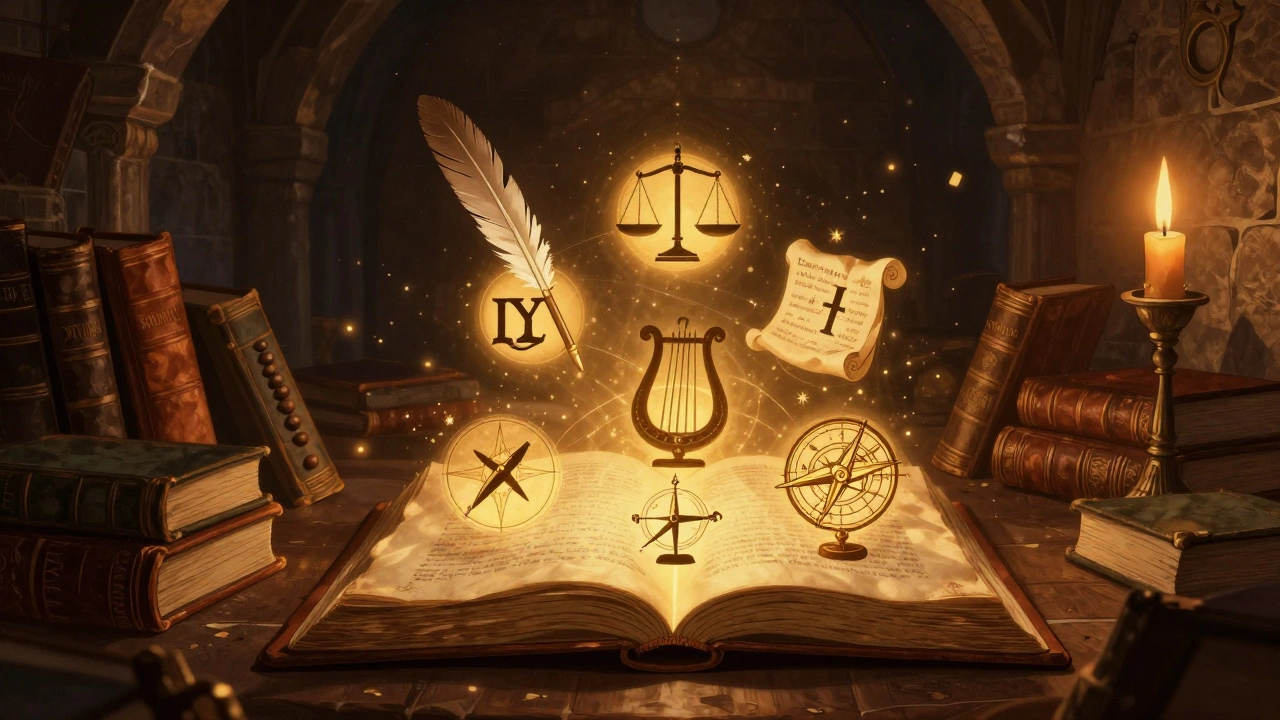
You’ve probably heard of the "seven liberal arts." Maybe you even know they split into the Trivium (language) and Quadrivium (math). But where does the number 63 arts come from? It’s not a secret club for contemporary artists, nor is it a modern curriculum standard. It’s a mathematical curiosity rooted in medieval philosophy that blew up on social media recently.
If you’re looking for a list of 63 specific painting techniques or digital design tools, you won’t find them here. Instead, we are digging into the intellectual history of how humans categorized knowledge. The concept of the 63 arts comes from the idea that if you combine the seven classical liberal arts with each other, you get 49 combinations, plus the original 7, plus their opposites or derivatives, reaching a theoretical total of 63 distinct branches of learning.
The Origin: From Seven to Sixty-Three
To understand the 63 arts, we have to go back to the Middle Ages. Thinkers like Boethius, a Roman philosopher who preserved Greek logic for the medieval world and later Isidore of Seville, a 7th-century bishop who wrote the first encyclopedia in Latin codified the seven liberal arts. These were considered the foundation of all free men’s education-skills that set you free from ignorance.
The math behind the 63 arts is simple but elegant. If you take the 7 core arts and ask, “What happens when these disciplines interact?” you start multiplying.
- 7 Core Arts: The foundational subjects.
- 49 Combinations: Every art paired with every other art (7 x 7).
- Total: 7 + 49 = 56. Some theorists added the “opposites” or “defects” of these arts, pushing the count to 63.
This wasn’t about creating new subjects like “Graphic Design” or “Film Theory.” It was a philosophical exercise in taxonomy. It showed how interconnected knowledge was. You couldn’t truly master rhetoric without understanding logic, and you couldn’t grasp geometry without arithmetic. The 63 arts represent the web of human understanding, not just a checklist of skills.
The Foundation: The Seven Liberal Arts
Before we can map out the complex web of 63, we need to nail down the roots. The seven liberal arts are divided into two groups: the Trivium, the three ways of using language to learn and the Quadrivium, the four ways of using numbers to understand the universe.
| Group | Art | Focus |
|---|---|---|
| Trivium | Grammar | Structure of language and symbols |
| Logic | Rules of valid reasoning and argument | |
| Rhetoric | Persuasive communication and expression | |
| Quadrivium | Arithmetic | Properties of numbers in the abstract |
| Geometry | Numbers in space and shape | |
| Music | Numbers in time and harmony | |
| Astronomy | Numbers in space and time |
Notice that “Art” in this context doesn’t mean painting or sculpture. In the medieval view, painting was a “mechanical art”-a craft for making things. The liberal arts were mental exercises. They were tools for thinking. This distinction is crucial. When people talk about the 63 arts today, they are often conflating “liberal arts” with “fine arts.” They are related, but they are not the same thing.
Mapping the Intersections: How 7 Becomes 63
So, how do we get from those seven basics to 63 specialized fields? Let’s look at some examples of these intersections. This is where the theory gets practical.
Take Logic and Geometry. When you combine them, you don’t just get “thinking about shapes.” You get Euclidean Geometry, a system of mathematical proof based on axioms and logical deduction. That’s one of the derived arts.
Now mix Rhetoric with Music. You get the study of poetic meter and lyrical persuasion. Mix Grammar with Astronomy, and you get the naming conventions of celestial bodies-the linguistic structure of the cosmos.
Here are a few more concrete intersections that form part of the 63:
- Arithmetic + Music: The mathematical ratios of musical intervals (Pythagorean tuning).
- Logic + Rhetoric: The art of debate and forensic argumentation.
- Geometry + Astronomy: Spherical trigonometry used to map the stars.
- Grammar + Logic: Semantics and syntax analysis.
Each of these combinations creates a unique lens through which to view reality. The medieval scholars believed that by mastering these intersections, a student could understand everything from the movement of planets to the structure of a perfect sentence.
Why the Number 63 Matters Today
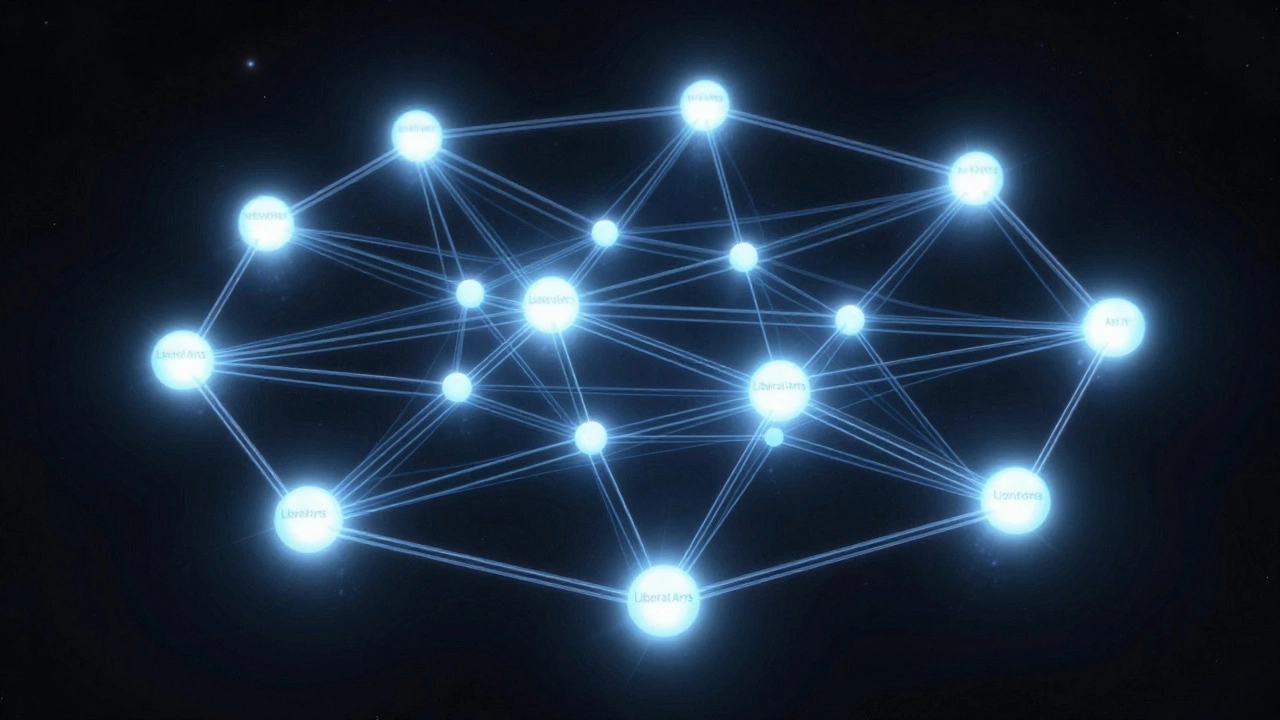
You might be wondering, “Why should I care about a medieval counting game?” The answer lies in how we organize information now. In the age of AI and big data, we are constantly trying to categorize knowledge. We create tags, metadata, and ontologies. The 63 arts model is an early example of a Knowledge Graph, a networked structure of data that shows relationships between entities.
It teaches us that no subject exists in a vacuum. If you are a designer, you aren’t just doing “visuals.” You are applying geometry (composition), arithmetic (grid systems), and rhetoric (visual persuasion). If you are a writer, you are using grammar, logic, and perhaps even music (rhythm of prose).
Understanding the 63 arts helps us break down silos. It encourages interdisciplinary thinking. In a world where specialization is king, remembering the connections between fields can lead to innovation. Steve Jobs famously said that Apple’s success came from connecting computer science with liberal arts. He was essentially tapping into the spirit of the 63 arts-finding value in the intersection of technology and humanity.

Misconceptions: What the 63 Arts Are Not
Let’s clear up some confusion. The 63 arts are not:
- A list of fine arts: Painting, sculpture, dance, and theater are not part of the original 63. They are “mechanical” or “performing” arts.
- A modern university curriculum: You won’t find a degree program called “Bachelor of the 63 Arts.”
- A secret society: Despite internet rumors, there is no hidden group guarding this list.
Instead, think of the 63 arts as a framework for lifelong learning. It’s a reminder that education is not about memorizing facts, but about understanding how different types of knowledge relate to each other.
Applying the Framework to Modern Creativity
How can you use this today? Whether you are an artist, a coder, or a marketer, you can apply the intersection method.
If you want to stand out, don’t just master one skill. Combine two. A programmer who understands rhetoric writes better user documentation. A musician who understands geometry can visualize sound waves and synthesize new textures. A photographer who understands astronomy can plan shoots around planetary alignments.
The 63 arts challenge you to expand your toolkit. Pick one discipline from the Trivium and one from the Quadrivium. Study how they overlap. You might discover a new niche or a fresh perspective on your current work.
Who created the list of 63 arts?
There is no single creator. The concept evolved from medieval scholars like Boethius and Isidore of Seville, who expanded on the seven liberal arts. The specific calculation of 63 comes from combining the 7 arts with their permutations and opposites, a philosophical exercise rather than a formal curriculum.
Are the 63 arts still taught in schools?
No, the specific list of 63 is not taught in modern schools. However, the underlying seven liberal arts (grammar, logic, rhetoric, arithmetic, geometry, music, astronomy) still form the basis of many humanities and STEM curricula, though they are often separated into different departments.
What is the difference between liberal arts and fine arts?
Liberal arts focus on intellectual development and critical thinking (e.g., logic, grammar). Fine arts focus on creative expression and craftsmanship (e.g., painting, sculpture). Historically, liberal arts were for free citizens, while fine arts were considered mechanical crafts.
Why is the number 63 significant?
The number 63 represents the total number of possible combinations and variations of the seven liberal arts. It symbolizes the comprehensive nature of human knowledge and the interconnectedness of different disciplines.
Can I learn the 63 arts online?
You can’t enroll in a course specifically for the “63 arts,” but you can explore the intersections yourself. Online platforms offer courses in logic, coding, music theory, and rhetoric. By combining these self-directed studies, you can recreate the interdisciplinary approach of the 63 arts.