The 13 Arts Explorer
Click on any discipline below to learn about its definition, medium, and place in the modern hierarchy of arts.
Select an Art Form
Historical ContextChoose a card above to begin exploring the landscape of human creativity.
Primary Medium
-
Key Characteristics
You’ve probably heard someone say they’re a “multi-disciplinary artist” or that they work across several fields. But when you dig into what that actually means, things get fuzzy fast. We all know painting and music. Maybe sculpture if we’re feeling cultured. But thirteen? That number sounds arbitrary until you realize it’s not just a random count-it’s a historical attempt to categorize every way humans have ever tried to express something beyond words.
The idea of classifying arts isn’t new. It goes back centuries, evolving as technology and culture changed. What started as seven classical arts has expanded, shifted, and split apart to reflect our modern reality. If you’re trying to figure out where your hobby fits, or you’re an artist wondering how to describe your portfolio without sounding pretentious, understanding this framework helps. It’s not about rigid boxes; it’s about recognizing the landscape of human creativity.
Key Takeaways
- The "13 arts" is a modern expansion of the traditional seven liberal arts, updated for digital and performance eras.
- Architecture and Film are now universally accepted as major artistic disciplines alongside Painting and Music.
- Digital Art and Video Games are increasingly recognized as the 13th discipline in contemporary discourse.
- Categorization varies by region and institution, but core visual, auditory, and performing arts remain stable.
- Understanding these categories helps artists position their work and helps viewers appreciate complex projects.
The Historical Foundation: From Seven to Twelve
To understand why we talk about thirteen, you have to look at where the counting started. In ancient Greece and later medieval Europe, scholars grouped knowledge into specific categories. The original Seven Liberal Arts were divided into the Trivium (grammar, logic, rhetoric) and the Quadrivium (arithmetic, geometry, astronomy, music). Notice anything missing? Visual creation wasn’t really on the list because it was considered craft, not high intellectual pursuit.
This changed dramatically during the Renaissance. Artists like Michelangelo weren’t just craftsmen anymore; they were intellectuals. By the 18th and 19th centuries, European academies began formalizing a list of fine arts. This was less about academic study and more about aesthetic value. The goal was to distinguish art made for beauty and expression from art made for utility.
For a long time, the standard list hovered around ten or eleven. You had Architecture, Sculpture, Painting, Drawing, Music, Poetry, Dance, Theater, Cinema, and sometimes Photography. These were the heavy hitters. They required skill, tradition, and institutional backing. But the world moved faster than the academies. New technologies emerged, and old boundaries blurred. We needed a bigger tent.
Defining the Core Traditional Arts
Let’s break down the disciplines that have held their ground for centuries. These aren’t controversial; they are the bedrock of the definition.
Architecture is often listed first because it shapes the space where other arts happen. It’s functional art. You can’t ignore a building the way you might ignore a bad song. It demands physical presence and engineering precision. Whether it’s a Gothic cathedral or a minimalist concrete museum, architecture balances utility with aesthetic intent.
Sculpture takes up space in three dimensions. Unlike a painting, which creates an illusion of depth, sculpture is depth. It interacts with light and shadow physically. From marble statues to modern kinetic installations, it forces the viewer to move around the object to understand it fully.
Painting remains the most recognizable form of visual art. It uses pigment on a surface to represent reality or abstract emotion. While digital tools have changed the process, the fundamental act-mark-making on a plane-is unchanged since cave walls. It’s immediate, personal, and historically significant.
Music organizes sound over time. It’s temporal, meaning it exists only while it’s happening. Once the note stops, the art is gone unless recorded. This ephemeral nature makes it powerful. It bypasses logic and hits emotion directly. From orchestral symphonies to electronic beats, it’s the universal language.
Poetry (or Literature) uses language as its medium. But unlike everyday speech, poetry focuses on rhythm, meter, and metaphor. It treats words as objects with weight and texture. It’s the art of saying the unsayable through precise linguistic choices.
The Performing and Time-Based Arts
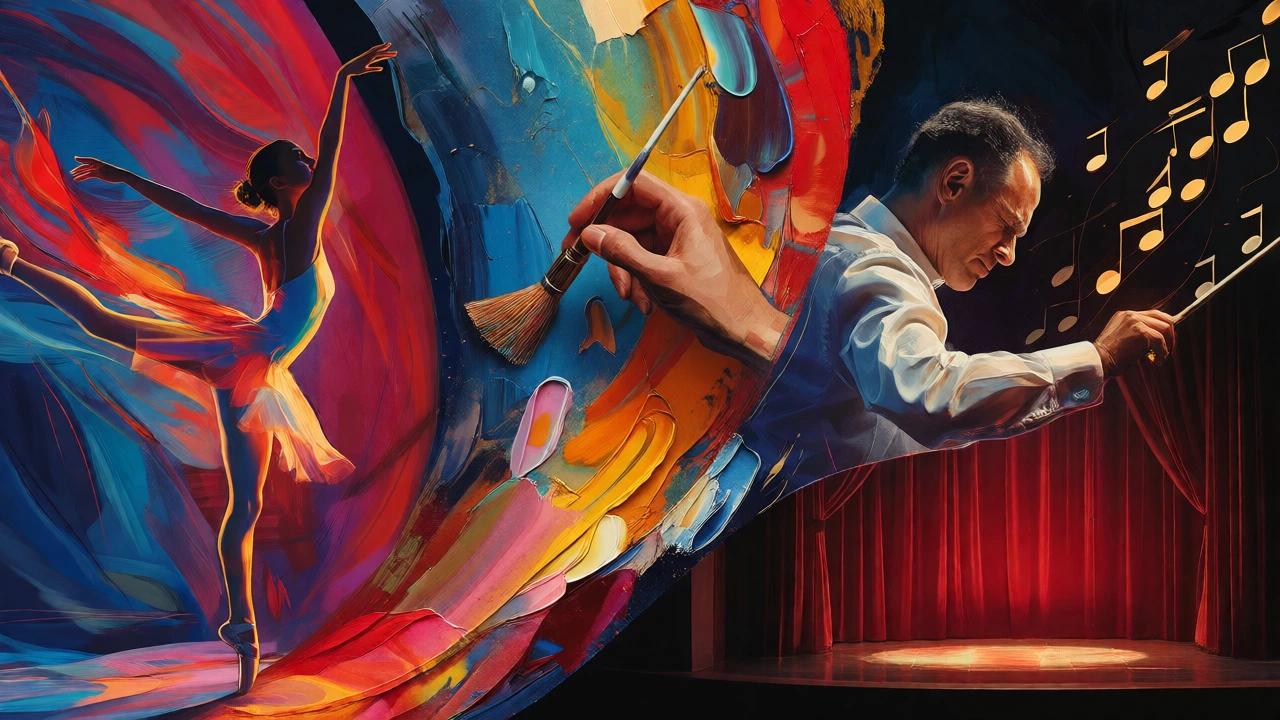
As society became more theatrical, performance entered the chat. These arts require a live element, even if captured later.
Dance uses the human body as the primary instrument. It conveys narrative or emotion through movement and gesture. It’s visceral. You feel dance in your own muscles when you watch it. Ballet, hip-hop, contemporary-each style carries cultural weight and technical rigor.
Theater combines acting, dialogue, and staging. It’s collaborative by nature. An actor, a playwright, and a director must align to create the final product. It’s dangerous because it happens live; mistakes are part of the experience. The energy between performer and audience is unique to this form.
Cinema (or Film) revolutionized storytelling. It merges visual art, music, theater, and literature into one timeline. Early critics dismissed it as cheap entertainment, but directors like Hitchcock and Kubrick proved it could be high art. It controls exactly what you see and hear, creating a curated sensory experience.
The Photographic and Digital Expansion
This is where the list gets tricky. Photography was excluded for decades because people argued it was mechanical reproduction, not creative interpretation. But once photographers like Ansel Adams and Diane Arbus demonstrated distinct artistic vision, it earned its spot.
Photography captures light to freeze a moment. It requires technical mastery of exposure and composition, but also an eye for timing and truth. It documents reality while interpreting it. In the age of smartphones, distinguishing artistic photography from casual snapshots is harder, but the principles remain the same.
Then came the computer. Digital Art emerged in the late 20th century. Initially mocked as "not real art," it has matured into a massive field including digital painting, 3D modeling, and generative art. Tools like Adobe Photoshop and Blender allow artists to manipulate pixels and polygons with infinite undo options. It’s not just a tool change; it’s a new medium with its own aesthetics.

The Debated 12th and 13th Arts
Here is where opinions clash. Some lists stop at twelve. Others push to thirteen. The candidates for these spots are usually Graphic Design, Comics, and Video Games.
Graphic Design applies visual communication to solve problems. Is it art? Many designers argue yes, citing works like Saul Bass’s movie posters or Paul Rand’s logos. It blends typography, imagery, and layout to convey messages. Critics say it’s commercial service, not pure expression. But in museums today, design exhibitions draw huge crowds.
Comics (or Sequential Art) combine drawing and writing. For years, they were seen as children’s fare. Then graphic novels like Maus won Pulitzer Prizes. The interplay of panel pacing and visual storytelling is a distinct skill set. It’s cinema on paper, controlling time through static images.
Finally, the contender for the 13th spot: Video Games. This is the newest frontier. Games involve visual art, music, narrative, and interactive design. Players don’t just watch; they participate. Titles like Journey or The Last of Us offer emotional arcs comparable to film. The MoMA in New York has already added video games to its permanent collection. If interaction counts as an artistic dimension, games deserve the title.
| Discipline | Primary Medium | Temporal Nature | Interactivity Level |
|---|---|---|---|
| Painting | Pigment/Surface | Static | Low (Visual) |
| Music | Sound | Time-based | Low (Auditory) |
| Dance | Body/Movement | Live/Time-based | Medium (Kinesthetic) |
| Film | Light/Camera | Time-based | Low (Passive Viewing) |
| Video Games | Digital Code/Graphics | Interactive Time | High (Active Participation) |
Why Categorization Matters Today
You might ask, why bother with this list? Does it matter if comics are art or just publishing? It matters because labels shape funding, education, and preservation. When a medium is recognized as an art, it gets grants. It gets taught in universities. It gets archived in libraries.
For creators, knowing where you fit helps you find your community. If you make interactive installations, you’re likely crossing the line between sculpture and video games. If you write lyrics, you’re in music and poetry. These overlaps are where innovation happens. The strict boundaries are dissolving anyway. Contemporary art thrives on hybridization.
Also, understanding the history prevents gatekeeping. Just because something wasn’t called "art" in 1750 doesn’t mean it isn’t now. Technology drives new forms. AI-generated images are currently fighting for recognition, much like photography did in the 1800s. Give it fifty years, and they’ll likely be included in the next update of this list.
Frequently Asked Questions
Are there officially 13 arts?
No, there is no single global governing body that fixes the number at 13. The concept originates from Italian theorist Ricciotto Canudo in the early 20th century, who proposed a hierarchy of arts. Different countries and institutions may include or exclude certain fields like cuisine or fashion, but the 13-arts model is widely cited in contemporary discussions.
Is cooking considered one of the arts?
Sometimes. In some extended lists, Cuisine is included as the 14th art or replaces others. However, in the standard 13-arts model derived from Western academic traditions, it is often excluded because it is primarily utilitarian (sustenance), though haute cuisine is frequently debated as an art form.
Why is architecture listed before painting?
In many historical classifications, architecture is listed first because it provides the physical context for other arts. Temples housed sculptures; churches hosted choirs; theaters staged plays. It is considered the foundational art of built environment.
Do video games qualify as art?
Increasingly, yes. Major institutions like the Museum of Modern Art (MoMA) have acquired video games for their permanent collections. They combine visual design, narrative, sound, and interaction, meeting the criteria for complex artistic expression.
What is the difference between fine art and applied art?
Fine art is created primarily for aesthetic or intellectual purposes (e.g., painting, sculpture). Applied art combines aesthetic design with practical function (e.g., graphic design, industrial design, ceramics). The 13 arts list tends to focus on fine arts, but includes some applied fields like architecture and design due to their cultural impact.