Who Was the First Modern Artist?
Art historians disagree on who started modern art. Take this quick quiz to see whose legacy aligns with your perspective.
Ask ten art historians who the first modern artist was, and you’ll likely get ten different names. Some will point to Claude Monet, arguing that his loose brushwork shattered academic rules in the late 19th century. Others might name Edgar Degas is a French artist associated with the Impressionist movement, known for his paintings, sculptures, and prints depicting dancers and bathers. Or perhaps they’ll cite Vincent van Gogh is a Dutch Post-Impressionist painter whose work had a far-reaching influence on 20th-century art through its emotional intensity and vivid color.. The debate gets messy because "modern art" isn’t just a style; it’s a mindset. It’s the moment artists stopped trying to copy reality perfectly and started interpreting it through their own subjective lenses.
But if we look past the painters and examine the very definition of "modernity"-the experience of rapid technological change, urbanization, and new ways of seeing-the title might belong to someone unexpected: Eadweard Muybridge is an English photographer best known for his pioneering work in motion capture and chronophotography. While not a painter, Muybridge fundamentally changed how humans perceive time and movement, influencing every major modern artist who followed him. Before we dive into why he deserves this distinction, let’s unpack what actually makes an artist "modern."
The Problem with a Single Answer
Art history doesn’t move in straight lines. It bubbles up from multiple places at once. In the mid-1800s, Europe was undergoing massive shifts. Industrialization was changing cities. Photography was threatening the traditional role of painting as the primary recorder of visual truth. Artists felt pressure to do something cameras couldn’t: capture emotion, memory, and perception.
This tension created several parallel movements. In France, Impressionists like Camille Pissarro is a Danish-French Impressionist painter who played a crucial role in the development of Impressionism. began painting outdoors (*en plein air*) to capture fleeting light. In Spain, Pablo Picasso is a Spanish painter, sculptor, printmaker, ceramicist and theatre designer who co-founded the Cubist movement. was still a child, but the seeds of abstraction were being sown by earlier figures like Gustave Courbet is a French painter who led the Realism movement in painting during the mid-19th century., who insisted on depicting ordinary life without idealization.
So, who was *first*? If you define modern art by technique, it’s the Impressionists. If you define it by philosophy, it might be the Symbolists. But if you define it by the disruption of human perception itself, the answer points toward technology-and specifically, photography.
| Artist | Movement/Role | Key Contribution to Modernity | Why They Might Be #1 |
|---|---|---|---|
| Claude Monet | Impressionism | Captured transient light effects | Broke from studio painting; focused on sensory experience over detail |
| Eadweard Muybridge | Photography/Motion Study | Decomposed motion into frames | Changed how artists understood movement, influencing Futurism and Cubism |
| Gustave Courbet | Realism | Depicted unidealized everyday life | Rejected mythological subjects; asserted art’s social relevance |
| Paul Cézanne | Post-Impressionism | Structured nature into geometric forms | Bridge between Impressionism and Cubism; emphasized form over light |
Why Eadweard Muybridge Changes the Conversation
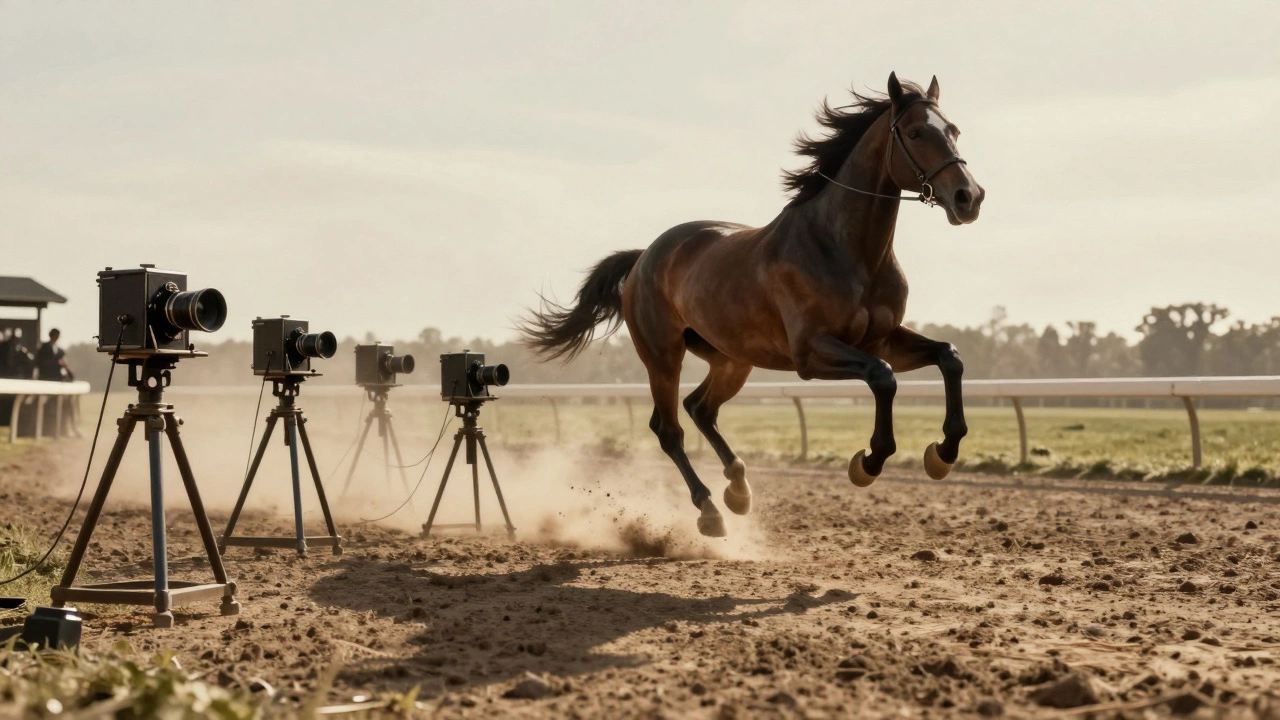
Most people think of modern art as paint on canvas. But modernity is also about how we see the world. In 1878, Leland Stanford, a railroad magnate and horse breeder, asked Muybridge a simple question: Do all four hooves of a galloping horse ever leave the ground at once? To answer it, Muybridge set up a battery of cameras along a racetrack. When the horse ran past, tripwires triggered each camera in sequence. The resulting photographs showed something no human eye had ever seen: moments of suspension in motion.
This wasn’t just science; it was art. By freezing time, Muybridge revealed that our eyes deceive us. We perceive smooth motion, but reality is a series of discrete instants. This insight shook the foundation of Western art, which had relied on continuous, idealized forms since the Renaissance.
Consider the impact on later artists. The Futurists, like Umberto Boccioni is an Italian artist who contributed significantly to the Futurist movement with his paintings, drawings, and sculptures., used fragmented forms to depict speed and dynamism. The Cubists, including Georges Braque is a French artist who co-developed Cubism with Pablo Picasso. and Picasso, broke objects into multiple viewpoints simultaneously. Both movements owed a debt to Muybridge’s revelation that perspective and motion are not fixed.
If modern art is defined by breaking from tradition to reveal new truths, Muybridge did exactly that. He didn’t just paint differently; he saw differently. And in doing so, he gave other artists permission to abandon realism entirely.
The Role of Technology in Shaping Modern Art
You can’t separate modern art from the industrial age. The invention of synthetic pigments allowed Impressionists to paint bright colors outdoors. The camera freed painters from the duty of documentation. Electricity enabled new mediums like film and performance art. Each technological leap forced artists to redefine their purpose.
Muybridge stood at the intersection of these changes. His work bridged science and art, proving that observation could be mechanical yet deeply aesthetic. Today, we take digital images for granted, but in the 1870s, seeing a horse in mid-air was revolutionary. It challenged the notion that art must represent what the eye sees, suggesting instead that art should reveal what the eye misses.
This shift is crucial. Modern art isn’t about beauty alone; it’s about inquiry. It asks: What is real? How do we perceive it? Can we trust our senses? Muybridge answered these questions before most painters even posed them.
Impressionism: The Traditional Contender
Let’s give credit where it’s due. For many, the birth of modern art coincides with the first Impressionist exhibition in Paris in 1874. Critics mocked the show, calling the works unfinished sketches. But artists like Monet, Renoir, and Sisley were doing something radical: they prioritized sensation over precision.
Monet’s *Impression, Sunrise* (1872) looks hazy compared to academic paintings of the time. But that haziness was intentional. It captured the feeling of dawn, not just its appearance. This focus on subjective experience became a hallmark of modern art. Later movements-Expressionism, Abstract Expressionism-all trace their lineage back to this idea: art reflects inner states, not outer facts.
Still, Impressionism retained some ties to representation. Even when blurred, the subjects remained recognizable. Muybridge went further. His sequences often dissolved form entirely, showing only patterns of movement. In that sense, he was more abstract than the Impressionists.
Philosophical Roots: Nietzsche and Beyond
Art doesn’t exist in a vacuum. The rise of modernism paralleled philosophical shifts. Friedrich Nietzsche declared that "God is dead," challenging absolute truths. Sigmund Freud explored the unconscious mind, revealing hidden layers of human behavior. These ideas resonated with artists seeking deeper meaning beyond surface appearances.
Muybridge’s work aligned with this intellectual climate. By exposing the mechanics of motion, he undermined the illusion of continuity. Similarly, artists like Salvador Dalí is a Spanish surrealist artist renowned for his technical skill, precise draftsmanship, and the dreamlike images in his work. would later use distorted realities to explore psychological depths. The thread connecting them is skepticism toward accepted norms-a core trait of modernity.
Global Perspectives: Was Modern Art Only European?
We tend to center modern art in Europe, but innovation happened elsewhere too. In Japan, Ukiyo-e woodblock prints influenced Van Gogh and Monet with their flat planes and asymmetrical compositions. In Africa, tribal masks inspired Picasso’s *Les Demoiselles d’Avignon*, a pivotal work in the development of Cubism.
These cross-cultural exchanges highlight another aspect of modernity: globalization. Artists borrowed freely across borders, creating hybrid styles. Muybridge himself traveled extensively, working in the US, UK, and South America. His global reach underscores how interconnected modern art truly was.
Recognizing diverse contributions enriches our understanding. While Muybridge may have been pivotal in reshaping perception, others played equally vital roles in expanding artistic language.
How to Identify Modern Art Today
So, how do you spot modern art now? Look for these traits:
- Rejection of realism: Subjects aren’t depicted accurately; they’re interpreted.
- Experimentation: New materials, techniques, or concepts are explored.
- Subjectivity: Personal vision takes precedence over objective truth.
- Innovation: Breaks from established traditions or conventions.
Whether it’s a painting, sculpture, photograph, or installation, modern art challenges viewers to engage actively. It demands interpretation rather than passive consumption.
Frequently Asked Questions
Was Claude Monet really the first modern artist?
Not necessarily. While Monet helped launch Impressionism, which marked a significant break from academic art, earlier figures like Gustave Courbet and photographers like Eadweard Muybridge contributed foundational ideas. Monet is often cited because his work popularized the movement, but he wasn’t the sole originator.
Why is Eadweard Muybridge considered important to modern art?
Muybridge revolutionized how we understand motion and time. His sequential photographs revealed details invisible to the naked eye, influencing movements like Futurism and Cubism. By challenging traditional perspectives, he paved the way for abstract and experimental approaches in art.
What defines modern art versus contemporary art?
Modern art generally refers to works produced between the 1860s and 1970s, characterized by experimentation and rejection of classical techniques. Contemporary art describes work created from the late 20th century onward, often addressing current social, political, or cultural issues using diverse media.
Did photography inspire modern painting?
Yes. Photography took over the role of realistic depiction, freeing painters to explore abstraction, emotion, and conceptual ideas. Many modern artists studied photographic techniques to inform their compositions and lighting choices.
Are there non-European contributors to modern art?
Absolutely. Japanese Ukiyo-e prints influenced Impressionists and Post-Impressionists. African art impacted Cubism. Indigenous and Asian traditions worldwide contributed unique aesthetics that shaped global modernism.
Ultimately, asking who the first modern artist was misses the point. Modernity emerged from countless innovations, collaborations, and rebellions. Whether you side with Monet’s brushstrokes or Muybridge’s shutter clicks, the real takeaway is this: modern art invites us to question everything-including who gets to decide what counts as art.