Art Era Classifier
Determine Art Era
Enter the year an artwork was created to identify whether it belongs to modern art (1860-1970) or contemporary art (1971-present)
People often use the terms modern art and contemporary art like they mean the same thing. But they don’t. Mixing them up is like calling a Model T a Tesla-both are cars, but they come from different times, with different rules, goals, and energy. If you’ve ever stood in front of a painting at a museum and wondered, "Is this modern or contemporary?"-you’re not alone. The confusion is everywhere, even in galleries and auction catalogs.
Modern art isn’t just "old" art
Modern art started around the 1860s and ran through the 1970s. It wasn’t just a style-it was a revolution. Artists began breaking away from centuries of tradition. No more perfect landscapes or idealized portraits. Instead, you got brushstrokes that looked like they were made in a hurry, colors that didn’t match reality, and shapes that didn’t follow the rules. Think Van Gogh’s swirling skies, Picasso’s fractured faces, or Matisse’s bold cut-outs. These weren’t accidents. They were deliberate rejections of what art "should" be.
Modern artists were responding to big changes: industrialization, urban life, new science, and world wars. They asked: What if art didn’t need to copy the world? What if it could express emotion, ideas, or inner turmoil? That’s why you see abstract forms, distorted figures, and experimental materials. Modern art was about finding a new visual language for a new world.
Contemporary art is art made now
Contemporary art starts where modern art ends-roughly the 1970s-and continues to today. It’s not a style. It’s not even a movement. It’s simply art being made right now, by living artists. That means it can be anything: a video of someone crying in a parking lot, a sculpture made of recycled plastic bottles, a performance where the artist sleeps in a gallery for a week, or an Instagram post that turns into an artwork.
Unlike modern art, which had clear schools-Cubism, Surrealism, Abstract Expressionism-contemporary art doesn’t follow one path. It’s messy, loud, and often political. Artists today tackle climate change, identity, surveillance, digital culture, and inequality. They use technology, social media, and everyday objects because those are the tools of our time. A contemporary artist might use AI to generate images, or turn a viral meme into a gallery piece. The medium doesn’t matter as much as the message.
Time is the biggest divider
The easiest way to tell them apart? Look at the date.
- If the artwork was made between 1860 and 1970, it’s modern art.
- If it was made after 1970, it’s contemporary art.
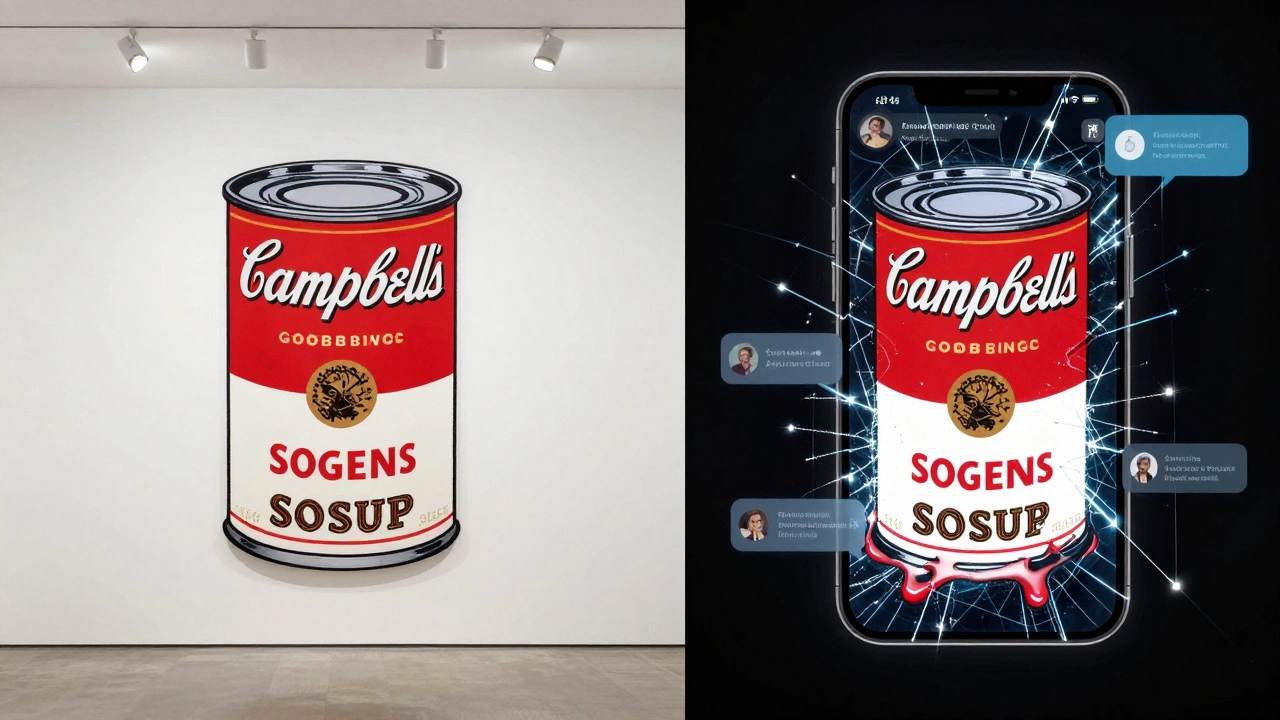
That’s it. No exceptions. A painting from 1965 is modern. One from 1975 is contemporary-even if it looks exactly the same. Context matters. A Warhol soup can from 1962 is modern. A similar soup can made in 2023 by a different artist? That’s contemporary. Same subject, different time, different meaning.
Think of it like music. Jazz from the 1920s is not the same as hip-hop from the 2020s, even if both use rhythm and sound. The era shapes the message.

Goals and intentions are different
Modern artists wanted to break free from tradition and create something new. They believed in progress, in the idea that art could evolve like science. They often worked within a framework-like formalism or expressionism-and their work was meant to be admired for its beauty, technique, or emotional power.
Contemporary artists don’t always care about beauty. They care about questions. Is art still valuable if it’s just a tweet? Can a factory-made object be art? Who gets to decide what’s important? Their work often challenges the viewer. It’s meant to provoke, confuse, or even offend. It doesn’t need to hang on a wall. It can be a protest, a podcast, or a public intervention.
Modern art asked: "What can art look like?" Contemporary art asks: "What can art do?"
Where you see them matters
You’ll find modern art in museums like MoMA in New York, the Tate Modern in London, or the Art Institute of Chicago. These institutions built their reputations on collecting modern masters: Monet, Kandinsky, Pollock, Rothko. Their galleries are quiet, well-lit, and carefully curated.
Contemporary art lives in biennials, artist-run spaces, pop-up galleries, and even online platforms. You might see it at the Venice Biennale, in a warehouse in Berlin, or on a smartphone screen. It’s less about permanence and more about impact. A piece might exist for only a day, then disappear.
Modern art is about legacy. Contemporary art is about now.
Materials and methods changed
Modern artists used paint, canvas, bronze, wood-traditional materials, even when they pushed boundaries. They still worked with brushes, chisels, and palettes. Their innovations were in form, not tools.
Contemporary artists use whatever’s available. LED screens, drones, biotechnology, virtual reality, social media algorithms, even human hair or food waste. An artist might use data from your Fitbit to generate a painting. Or turn your Twitter feed into a sculpture. The tools reflect the world we live in-digital, fast, connected, and often overwhelming.
One artist in Vancouver, for example, used melted-down plastic bottles from local beaches to create a floating sculpture that drifted in False Creek. It wasn’t just art-it was a statement about pollution. That’s contemporary art: deeply tied to place, time, and urgent issues.
Who decides what counts?
Modern art had gatekeepers: critics, collectors, and museums. If they said it was art, it was art. The system was centralized and hierarchical.
Contemporary art is more democratic-and chaotic. Anyone can make it. Anyone can call it art. Instagram influencers, street artists, and even AI-generated images are now part of the conversation. Galleries still matter, but so do TikTok trends and NFT marketplaces. The power to define art has shifted from a few experts to a global network of creators and viewers.
That’s why you’ll hear debates like: "Is a JPEG really art?" or "Can a tweet be a masterpiece?" Modern art didn’t ask those questions. Contemporary art lives in them.
It’s not about which is better
Neither modern nor contemporary art is superior. They’re responses to different moments in history. Modern art gave us freedom from tradition. Contemporary art gives us tools to question everything-including the idea of art itself.
If you like clean lines and emotional depth, you might connect more with modern art. If you like surprises, challenges, and art that speaks to today’s chaos, contemporary art will feel more alive to you.
And that’s okay. You don’t have to like both. But you should know the difference-because when you walk into a gallery, you’ll understand what you’re really seeing.
Is contemporary art just modern art that’s recent?
No. While contemporary art comes after modern art, they’re not just different dates on a timeline. Modern art was a defined movement with shared goals-breaking from tradition, exploring form and emotion. Contemporary art has no single style or mission. It’s whatever artists are making right now, using any medium, to respond to today’s world. The difference is in purpose, not just time.
Can a painting from the 1980s be considered modern art?
No. Even if a painting from 1985 looks like something from the 1950s, it’s still contemporary art because it was made after 1970. The classification is based on when it was created, not how it looks. Modern art ended around the 1970s. After that, it’s contemporary, regardless of style.
Why do museums sometimes label contemporary art as modern?
It’s usually a mistake-or a simplification for visitors. Many people don’t know the difference, so museums sometimes use "modern" as a catch-all term for art that isn’t classical. But in art history circles, that’s inaccurate. Professionals avoid it. If you see "modern" used for art from the 2000s, it’s likely an error.
Is abstract art always modern?
No. Abstract art began in the early 20th century and was a key part of modern art. But abstract forms are still used today in contemporary art. A painting with swirling colors made in 2024 is abstract-but it’s contemporary, not modern. Style doesn’t determine the category; the time period does.
Do contemporary artists ever reference modern art?
Yes, all the time. Many contemporary artists quote, parody, or critique modern masters. For example, an artist might recreate a Rothko painting using only LED lights, or make a digital version of a Mondrian grid that changes with the weather. These aren’t copies-they’re conversations with the past. That’s part of what makes contemporary art so rich: it’s always talking to what came before.
What to look for next
If you want to see the difference for yourself, visit a museum with both collections. Look at a Pollock from 1950 and a Julie Mehretu from 2018. Pollock’s drip paintings feel like raw emotion frozen in time. Mehretu’s layered, chaotic drawings use architecture, maps, and digital noise to reflect global systems. One is about inner feeling. The other is about the world outside.
That’s the gap. Modern art looks inward. Contemporary art looks outward-and it’s still changing.