Rule of Thirds Composition Planner
You have mixed your colors perfectly. The light looks right. Your brushwork is confident. But when you step back, the painting feels... off. It’s not messy, but it lacks that professional polish. This is often a composition problem, and more specifically, it’s usually about where you placed your main subject.
This is where the rule of thirds comes in. It is one of the most fundamental concepts in visual art, yet many painters struggle to apply it effectively with wet paint. Unlike digital art, where you can drag a layer until it snaps into place, oil painting requires you to think ahead. You cannot easily move a large tree or a figure once the underpainting is set.
Understanding this grid system will transform how you arrange elements on your canvas. It helps create tension, energy, and interest rather than static symmetry. Let’s break down exactly what it is, why it works, and how to use it in your next oil painting session.
Understanding the Grid Structure
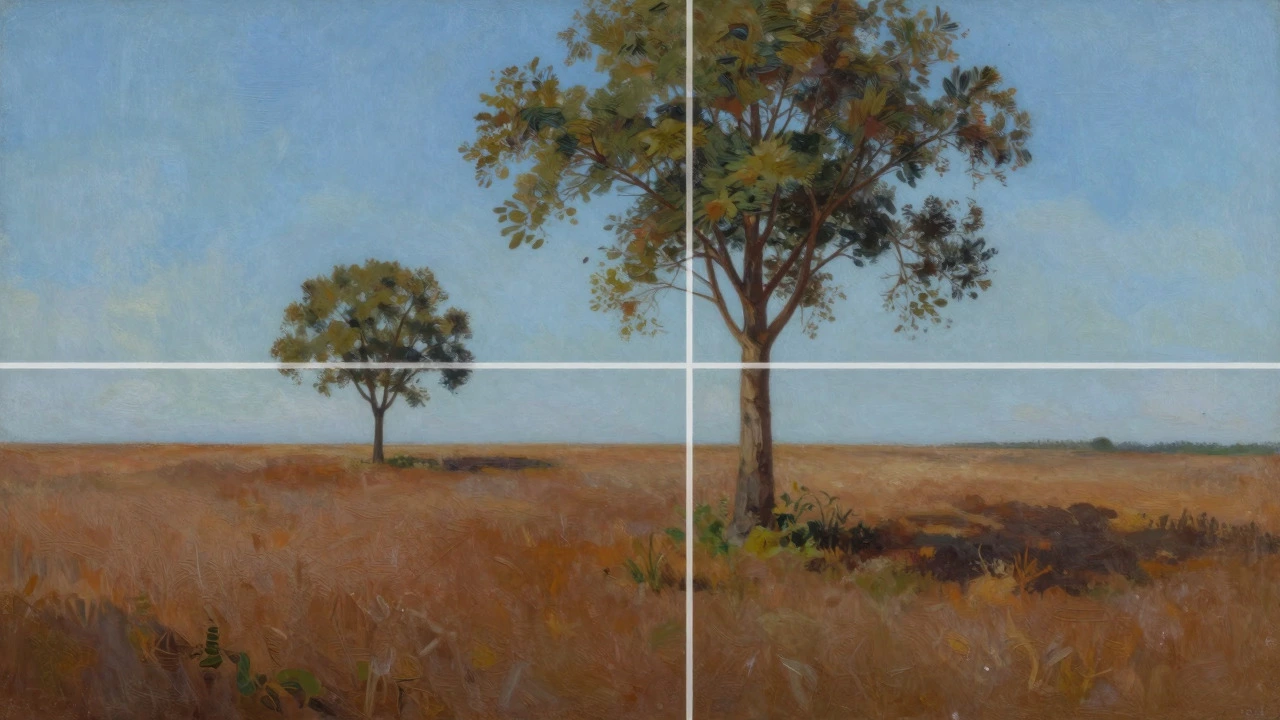
The rule of thirds is simple to define but requires practice to master. Imagine dividing your canvas into nine equal parts by drawing two equally spaced horizontal lines and two equally spaced vertical lines. These lines create four intersection points.
Composition relies on these intersections as "power points." When you place your focal point-whether it is a person's eye, a flower, or a distant mountain peak-near one of these intersections, the image becomes naturally more engaging to the viewer.
Why does this work? Human eyes tend to avoid the exact center of an image. We scan across a picture. By placing key elements off-center, you guide the viewer’s eye through the entire scene rather than letting it rest immediately in the middle. This creates a dynamic flow.
- Horizontal Lines: Place the horizon line on either the top or bottom third line. Never put it dead center unless you are aiming for a specific mirror-like effect.
- Vertical Lines: Align tall objects like trees, buildings, or standing figures along these lines.
- Intersections: Position your primary subject at one of the four crossing points.
Why Centered Composition Often Fails
Placing your subject directly in the center of the canvas is the default setting for beginners. It feels safe. However, in oil painting, central placement often results in a static, boring image. It splits the canvas into two equal halves, giving the viewer no reason to explore one side over the other.
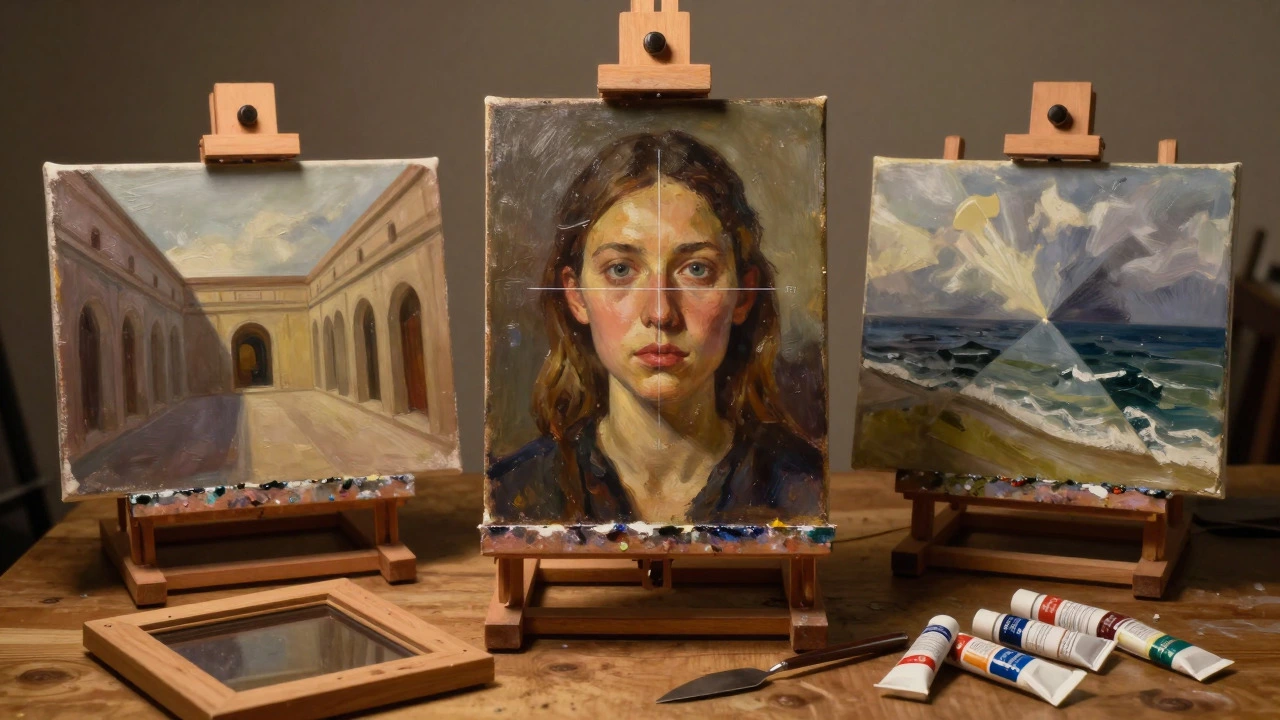
Consider a portrait. If the face is dead center, the background becomes merely empty space. If you shift the face to the left vertical third line and look toward the right empty space, you create "looking room." The viewer anticipates where the subject is looking. This adds narrative depth without saying a word.
In landscapes, a centered horizon line divides the sky and earth equally. This is rarely interesting. Nature is rarely balanced so perfectly. By lowering the horizon to the bottom third, you emphasize the vastness of the sky. By raising it to the top third, you highlight the texture and detail of the foreground terrain.
Applying the Rule in the Sketch Phase
Oil paint is unforgiving if you get the layout wrong early on. You cannot simply erase a misplaced mountain. Therefore, the rule of thirds must be applied during the initial sketch or underpainting stage.
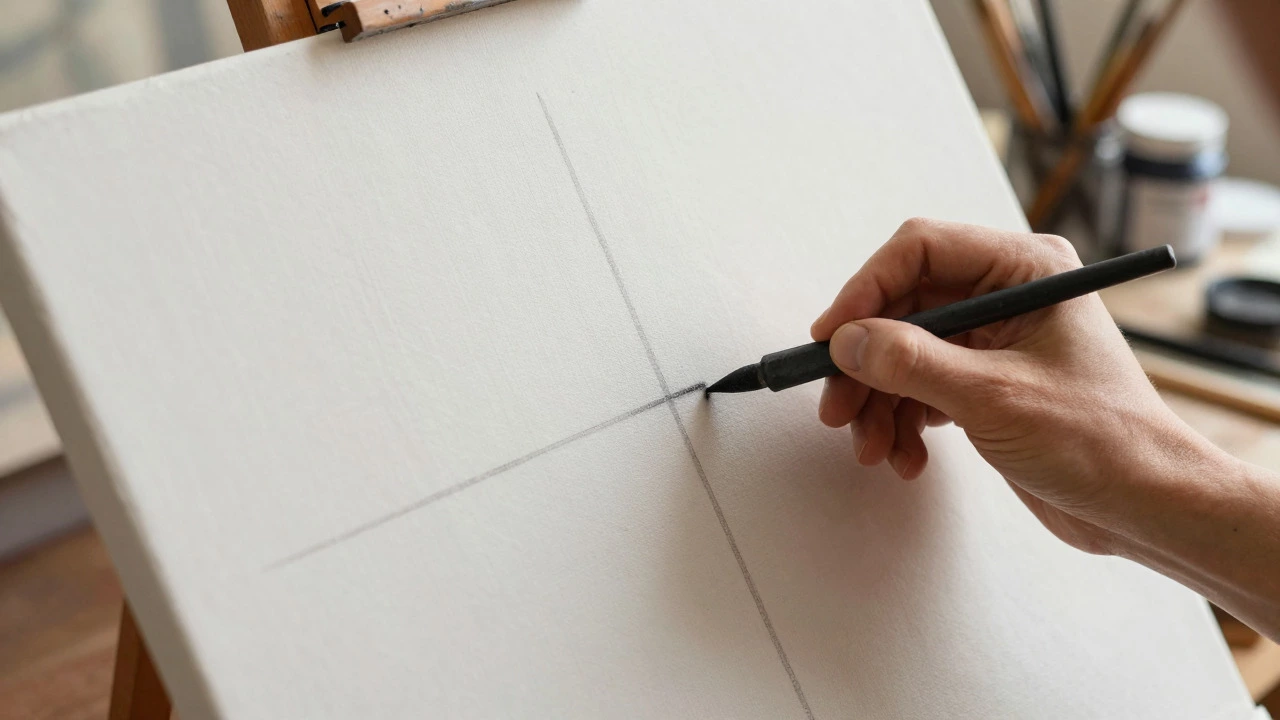
Start by lightly marking your canvas with charcoal or thinned wash. Draw the faint grid lines. Use these marks to block in your major shapes. Ask yourself: Where is my strongest area of contrast? That should align with a power point.
Use a monochromatic underpainting, such as raw umber or burnt sienna diluted with odorless mineral spirits. This allows you to see the values and composition clearly before applying opaque color. Check your alignment against the grid. Is the main tree trunk aligned with the right vertical line? Is the horizon resting on the lower horizontal line?
If something feels unbalanced, adjust the sketch now. It takes five minutes to redraw a line with charcoal. It takes hours to scrape off dried oil paint.
Advanced Techniques: Breaking and Using the Rule
Once you understand the rule, you can begin to bend it. Art is not about following rigid laws; it is about making informed choices. Sometimes, breaking the rule of thirds creates a powerful impact.
For example, symmetry is effective in architectural paintings or serene lake scenes where reflection is key. In these cases, centering the subject emphasizes stability and calm. However, this should be a deliberate choice, not a mistake.
Another advanced technique involves using multiple focal points. Instead of one subject at a single intersection, place three subjects at different intersections. Connect them visually with lines of sight, color echoes, or directional brushstrokes. This creates a triangular composition that keeps the viewer’s eye moving in a loop around the canvas.
Also, consider the golden ratio. While the rule of thirds is a simplified approximation, the golden ratio (1:1.618) offers a more complex spiral arrangement. Many classical masters used this organic curve to place their subjects. For modern oil painters, the rule of thirds is a faster, easier proxy for achieving similar aesthetic balance.
Common Mistakes to Avoid
Even experienced painters make errors when applying compositional rules. Here are the most frequent pitfalls:
- Ignoring the Background: You place the subject correctly but clutter the background with competing elements. Ensure the background supports the focal point, not fights it.
- Cutting Off Limbs: In portraits, avoid cutting wrists or ankles exactly at the edge of the canvas. Use the grid to ensure limbs extend comfortably within the frame.
- Over-Correction: Don’t force every element onto the grid. Only the primary focal points need strict adherence. Secondary elements can fill the remaining spaces freely.
- Forgetting Depth: The rule of thirds applies to the 2D surface, but remember to create 3D depth through atmospheric perspective. Objects further away should be lighter and cooler in tone.
Practical Exercises for Mastery
The best way to learn is to do. Try these exercises in your next studio session:
- Thumbnail Sketches: Before starting a large painting, draw ten small 2x2 inch thumbnails. Experiment with placing the subject at different intersections. See which version feels most balanced.
- Photo Analysis: Take photos of your favorite paintings. Overlay a grid. Notice how the artists placed key elements. You will likely find they adhered closely to the rule of thirds.
- Landscape Study: Go outside with a viewfinder. Frame a scene. Move slightly left or right until the main subject aligns with a third line. Paint from that adjusted viewpoint.
Comparison: Rule of Thirds vs. Other Compositional Tools
| Technique | Best Used For | Difficulty Level | Visual Effect |
|---|---|---|---|
| Rule of Thirds | Landscapes, Portraits, General Scenes | Beginner | Balanced, Dynamic, Natural |
| Golden Ratio | Classical Realism, Complex Narratives | Advanced | Organic, Harmonious, Subtle |
| Symmetry | Architecture, Reflections, Minimalism | Intermediate | Stable, Calm, Formal |
| Diagonal Composition | Action Scenes, Stormy Seas | Intermediate | Unstable, Energetic, Dramatic |
Frequently Asked Questions
Do I need to follow the rule of thirds strictly?
No. The rule of thirds is a guideline, not a law. Once you understand why it works, you can break it intentionally to create specific moods, such as tension or symmetry. However, for beginners, sticking to the rule helps build a strong foundation in visual balance.
Can I use the rule of thirds in abstract oil painting?
Yes. Even in abstract art, there is a focal point-a cluster of intense color, texture, or movement. Placing this area of high contrast near a third-line intersection helps anchor the composition and prevents the painting from feeling chaotic or scattered.
How do I check my composition while painting?
Step back frequently. Squint your eyes to simplify the values. You can also hold up a card with a cross drawn on it to visualize the grid over your canvas. Another trick is to view your painting upside down; this removes the semantic meaning of objects and lets you see purely the shapes and their placement.
What if my subject doesn't fit neatly into the grid?
Focus on the most important part of the subject. For a person, it’s the eyes. For a building, it might be the roofline or entrance. Align that specific detail with the intersection, even if the rest of the object extends beyond the grid lines.
Is the rule of thirds only for oil painting?
No. It applies to photography, watercolor, acrylics, digital art, and even graphic design. It is a universal principle of visual perception that helps audiences process images more comfortably.