Digital Art Type Identifier
Select the characteristics that best describe your creative goal:
Ready to Identify
Configure your preferences and click "Identify Art Type" to see recommendations.
Is a JPEG made in Photoshop really "art"? For decades, this question sparked heated debates in galleries and living rooms alike. Today, the answer is a resounding yes, but the definition has expanded far beyond simple computer graphics. Digital art is a creative practice that uses digital technology as an essential part of the artistic process or presentation. It encompasses everything from a quick sketch on an iPad to complex algorithmic installations.
The line between traditional and digital methods has blurred significantly. If you have ever seen a movie with CGI effects, scrolled through Instagram filters, or bought an NFT, you have encountered digital art. Understanding what qualifies helps you appreciate the medium, whether you are an artist looking to start creating or a collector trying to understand the market.
The Core Definition: Technology as the Medium
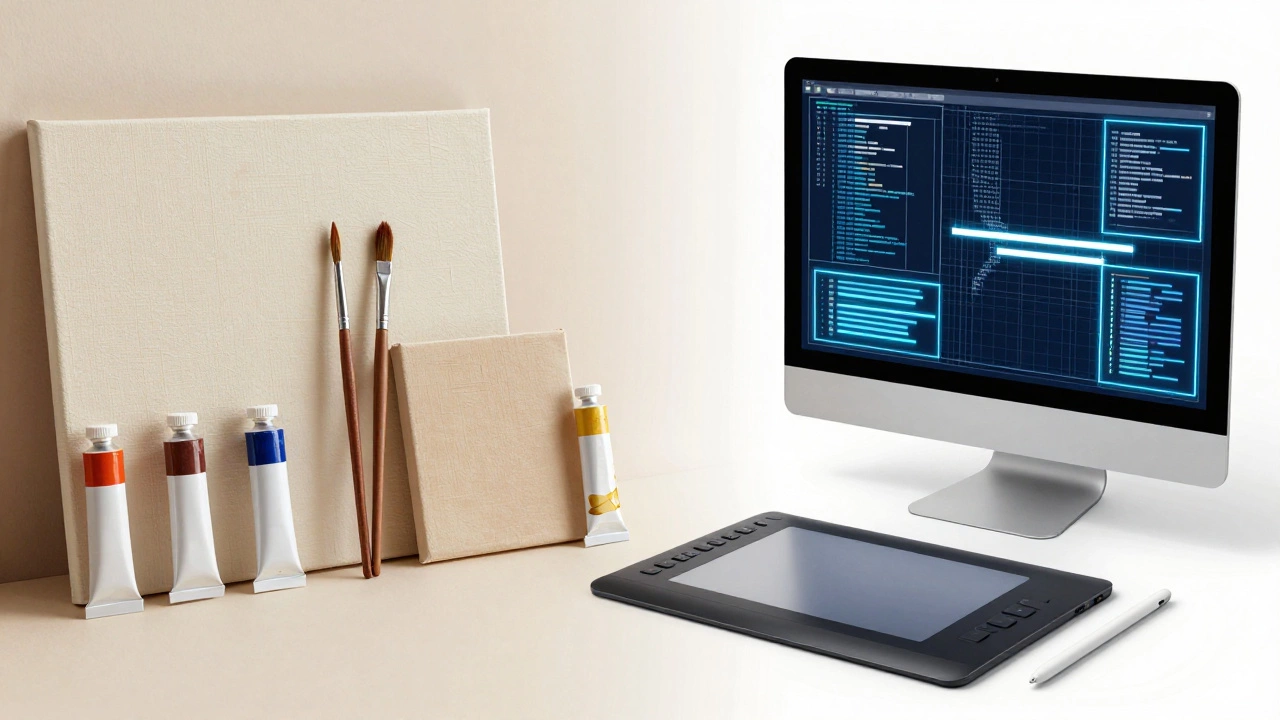
To define digital art accurately, we must look at the role of the technology. In traditional painting, the artist manipulates physical pigment. In digital art, the artist manipulates pixels, vectors, or code. The key distinction is not just the final output format (which can be printed on canvas), but the creation process.
Computer-generated imagery (CGI) is visual content created using computers, ranging from 2D illustrations to 3D animations. This broad umbrella covers several distinct categories. If the digital tool is merely used for storage or minor editing of a traditional work, it might not qualify as pure digital art. However, if the digital environment is where the creation happens-where brushstrokes are simulated by algorithms and layers are managed digitally-it fits the definition perfectly.
This shift changed how artists think about mistakes. In oil painting, a mistake might require scraping off paint or starting over. In digital workflows, the undo command allows for infinite experimentation. This freedom encourages risk-taking and rapid iteration, fundamentally altering the creative mindset.
Major Types of Digital Art
Digital art is not a monolith. It includes various sub-genres, each with its own tools and techniques. Here are the most common forms you will encounter today:
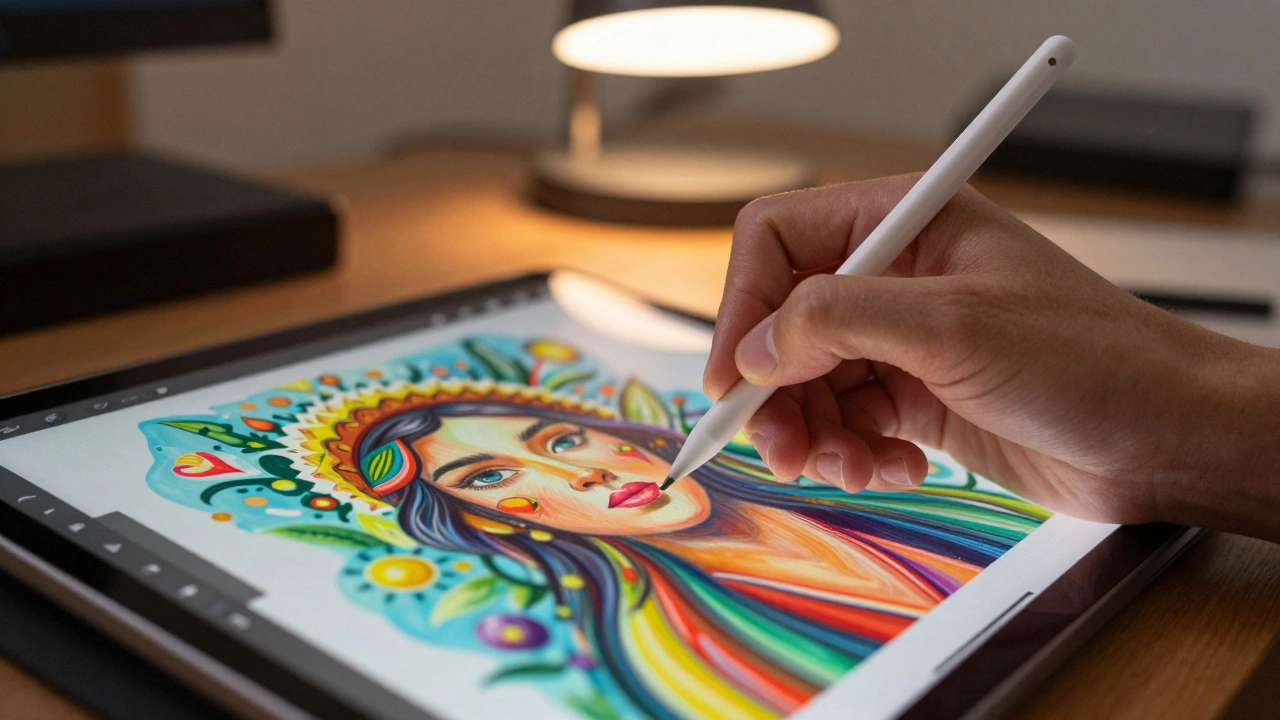
- Digital painting: Art created using software like Adobe Photoshop or Procreate to simulate traditional media such as watercolors, oils, or acrylics. Artists use styluses on tablets to mimic pressure sensitivity and texture.
- Vector graphics: Images based on mathematical equations rather than pixels, allowing for infinite scalability without loss of quality. This is standard for logos, icons, and flat design illustrations.
- 3D modeling: The process of constructing a mathematical representation of any three-dimensional surface using specialized software. Used extensively in video games, architecture, and product design.
- Generative art: Art created in whole or in part by a system, often autonomous, such as an algorithm or AI model. The artist sets the rules, and the computer generates the outcome.
- Pixel art: A digital art form where images are edited on the pixel level, often evoking retro video game aesthetics.
Each type serves different purposes. Vector graphics are ideal for branding because they remain crisp at any size. Digital painting is popular for concept art in film and gaming due to its expressive potential. Generative art appeals to those interested in the intersection of coding and creativity.
Essential Tools for Creating Digital Art
You do not need a million-dollar studio to create digital art. The barrier to entry has lowered dramatically. However, having the right hardware and software makes a significant difference in workflow efficiency and result quality.
| Software | Best For | Pricing Model | Platform |
|---|---|---|---|
| Adobe Photoshop | Photo manipulation, raster painting | Subscription | Windows, macOS |
| Procreate | iPad illustration, intuitive drawing | One-time purchase | iOS |
| Blender | 3D modeling, animation, VFX | Free/Open Source | Windows, macOS, Linux |
| Adobe Illustrator | Vector graphics, logo design | Subscription | Windows, macOS |
Hardware-wise, a Graphics tablet (or pen display) is crucial for natural drawing experiences. Brands like Wacom and Huion dominate this space. Alternatively, the Apple Pencil paired with an iPad has revolutionized mobile digital art, allowing creators to draw anywhere. For 3D work, a powerful GPU (graphics processing unit) is non-negotiable to handle rendering times efficiently.
The Role of AI in Modern Digital Art
In 2026, artificial intelligence is no longer a fringe topic; it is central to the conversation about what constitutes digital art. AI-generated art refers to images created by machine learning models trained on vast datasets of existing artwork. Tools like Midjourney, DALL-E 3, and Stable Diffusion allow users to generate complex images from text prompts.
This raises ethical and definitional questions. Is the prompter the artist? Or is the AI the artist? Most experts argue that when an artist curates, edits, and directs the AI output, it becomes a collaborative digital art form. The human provides intent and aesthetic judgment, while the machine executes the technical generation. This hybrid approach is becoming increasingly accepted in professional industries, particularly for storyboarding and conceptual design.
However, controversy remains regarding copyright and training data. Many traditional digital artists feel threatened by AI's ability to replicate styles instantly. As regulations evolve, the definition of "authorship" in digital art will likely become more nuanced, distinguishing between pure AI generation and AI-assisted creation.
Selling and Collecting Digital Art
Historically, digital art faced a unique challenge: it could be copied infinitely with zero degradation. How do you sell something that anyone can screenshot? The rise of blockchain technology introduced a solution through Non-Fungible Tokens (NFTs). An NFT acts as a certificate of authenticity and ownership for a digital file, recorded on a decentralized ledger.
While the NFT hype cycle cooled after its peak in 2021-2022, the underlying utility remains. Serious collectors still use NFTs to verify provenance and support artists directly. Platforms like OpenSea and Foundation facilitate these transactions. Additionally, many digital artists sell high-quality physical prints of their digital works, bridging the gap between the virtual and physical worlds.
Licensing is another major revenue stream. Digital artists frequently license their work for merchandise, advertising, and editorial use. Because digital files are easy to distribute, contracts must clearly specify usage rights, exclusivity, and duration to protect the creator's income.
Common Misconceptions About Digital Art
Despite its mainstream acceptance, myths persist. One common belief is that digital art is "easier" than traditional art. This overlooks the steep learning curve of mastering complex software interfaces, layer management, and color theory in RGB spaces. Another myth is that digital art lacks "soul" because it is clean and precise. Yet, digital tools offer textures, brushes, and effects that can convey deep emotion and imperfection, mimicking or even surpassing traditional mediums.
Understanding these realities helps demystify the field. Digital art is not a shortcut; it is a different set of skills requiring dedication, practice, and technical knowledge alongside artistic vision.
Is digital art considered real art?
Yes, digital art is widely recognized as a legitimate art form by museums, galleries, and academic institutions. Major museums like the Museum of Modern Art (MoMA) and the Smithsonian have acquired and exhibited digital artworks. The validity of art comes from the creative intent, skill, and emotional impact, not just the physical medium used.
What is the difference between digital art and graphic design?
While both use similar tools, their goals differ. Graphic design focuses on communication, solving specific problems, and conveying messages to an audience (like logos or ads). Digital art prioritizes self-expression, aesthetic exploration, and personal vision, often without a commercial brief driving the initial creation.
Do I need expensive equipment to start digital art?
Not necessarily. You can start with a smartphone and free apps like Ibis Paint X or Krita on a basic laptop. While a dedicated graphics tablet and powerful computer improve the experience, many professional artists began with modest setups. Skill development is more important than gear initially.
Can digital art be sold physically?
Absolutely. Many digital artists print their work on high-quality paper, canvas, or metal using professional printers. These physical prints are sold as fine art pieces. The digital file serves as the master source, allowing for consistent reproduction across various materials.
How does AI affect the future of digital artists?
AI is changing the workflow rather than replacing artists entirely. It automates tedious tasks like background generation or upscaling, allowing artists to focus on composition and concept. However, artists who adapt by integrating AI into their pipeline while maintaining a unique style and voice will thrive. Pure reliance on AI without curation may lead to generic results.