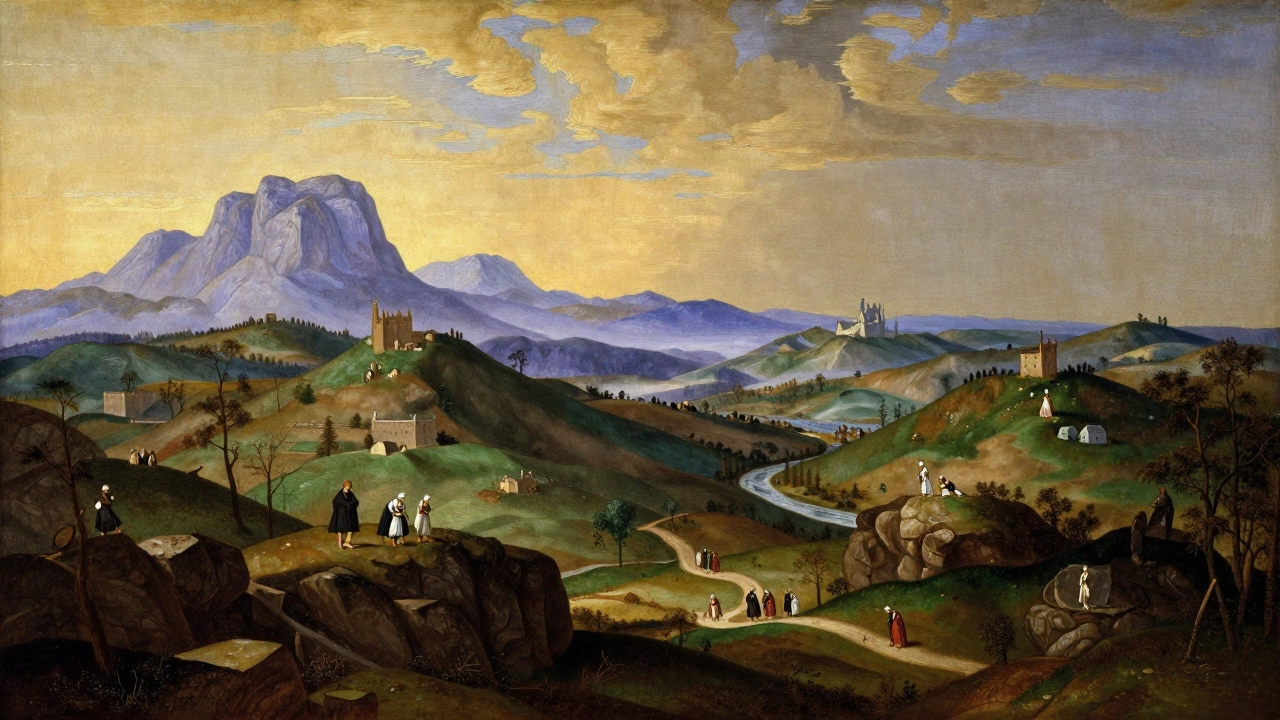
For over a thousand years after the fall of Rome, Western art focused almost entirely on religious figures, saints, and biblical scenes. Landscapes? They were just background filler-distant hills, a tree here, a river there-never the point of the painting. Then, in the early 1500s, something changed. A painter from the Low Countries broke the mold. He didn’t just paint a landscape as an afterthought. He made it the whole story. That painting is widely recognized today as the first true landscape since antiquity: Joachim Patinir’s World Landscape.
Why Landscape Painting Disappeared After Antiquity
The Romans and Greeks had mastered landscape painting. Frescoes in Pompeii show rolling hills, gardens, and distant mountains with real depth and atmosphere. But after the collapse of the Western Roman Empire, those skills faded. Art became a tool for the Church. Its job was to teach scripture, not to capture nature. So painters focused on figures-Christ, the Virgin Mary, angels. The world around them? Just a flat green stripe behind the saints.
By the 1400s, artists like Jan van Eyck started adding more detail to backgrounds. You’d see a castle on a hill, or a river winding through trees. But these weren’t landscapes. They were settings for religious events. The landscape still served the story, not the other way around.
Joachim Patinir: The Man Who Changed Everything
Joachim Patinir was born around 1480 in what’s now Belgium. He didn’t paint altarpieces. He didn’t do portraits. He painted vast, sweeping scenes where nature was the main character. His paintings were big, often over a meter wide, filled with jagged mountains, winding rivers, tiny pilgrims walking along paths, and distant cities glowing under golden skies.
His most famous work, World Landscape (c. 1515-1524), shows a panoramic view stretching from a rocky foreground to a hazy horizon. The figures-Saint Jerome, a hermit, and a small group of travelers-are almost lost in the scene. That’s the point. They’re not the focus. The land is.
Patinir didn’t copy real places. He invented them. He stacked mountains, exaggerated cliffs, and arranged rivers like ribbons to guide your eye across the canvas. This was the first time a painter treated nature as something worthy of awe on its own-not just as a backdrop for holy figures.
How Patinir’s Style Was Different
Before Patinir, landscape elements were decorative. After him, they became structural. His paintings follow a clear visual formula:
- Foreground: Dark, rocky terrain with small figures or animals-often a hermit or a traveler.
- Middleground: Rolling hills, rivers, towns, and castles-carefully placed to lead the eye forward.
- Background: Distant mountains bathed in pale blues and purples, fading into mist.
This three-layer structure became the blueprint for landscape painting for the next 200 years. Artists like Pieter Bruegel the Elder borrowed it. So did later Dutch masters like Jacob van Ruisdael. Even today, photographers and filmmakers use this same technique to create depth and drama.
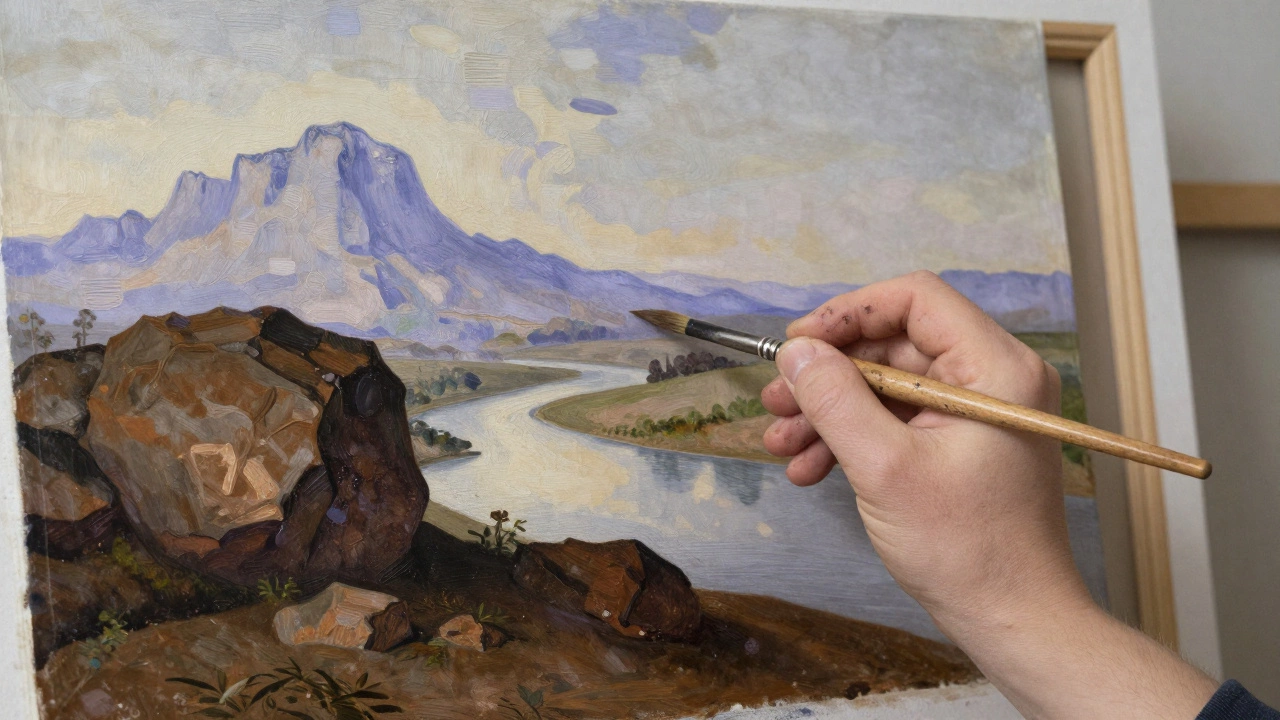
Patinir’s use of color was revolutionary too. He didn’t paint skies as flat blue. He layered hues-pale yellow near the horizon, soft lavender above, cool gray in the distance. He used atmospheric perspective long before Leonardo da Vinci wrote about it. His mountains weren’t just shapes-they felt like real places you could walk into.
Why It’s Called a ‘World Landscape’
The term ‘World Landscape’ (or Weltlandschaft in German) was coined by art historians later, but it fits perfectly. Patinir didn’t paint one place. He painted the idea of the world. His scenes mixed real geography with myth and memory. You might see a biblical scene next to a Flemish village next to a mountain range that looks like the Alps but isn’t.
This wasn’t about accuracy. It was about scale. He wanted viewers to feel small-like a pilgrim in a vast, mysterious world. That emotional response was new. It turned landscape painting from a technical exercise into a spiritual experience.
Who Else Was Painting Landscapes Around the Same Time?
Some might point to Albrecht Dürer’s watercolor sketches from the 1490s. He painted trees and mountains in Switzerland with incredible detail. But those were studies-private, not public works. They weren’t finished paintings meant for display.
Leonardo da Vinci sketched landscapes too, but his famous Monte San Giorgio wasn’t painted as a standalone piece. It was a study for a larger composition. And even though he theorized about atmospheric perspective, he never made a full-scale landscape painting that placed nature as the subject.
Other Northern Renaissance painters like Hieronymus Bosch included wild landscapes in their works-but they were surreal, symbolic, and often chaotic. Patinir’s landscapes were calm, ordered, and inviting. They made nature feel sacred without needing saints or angels.
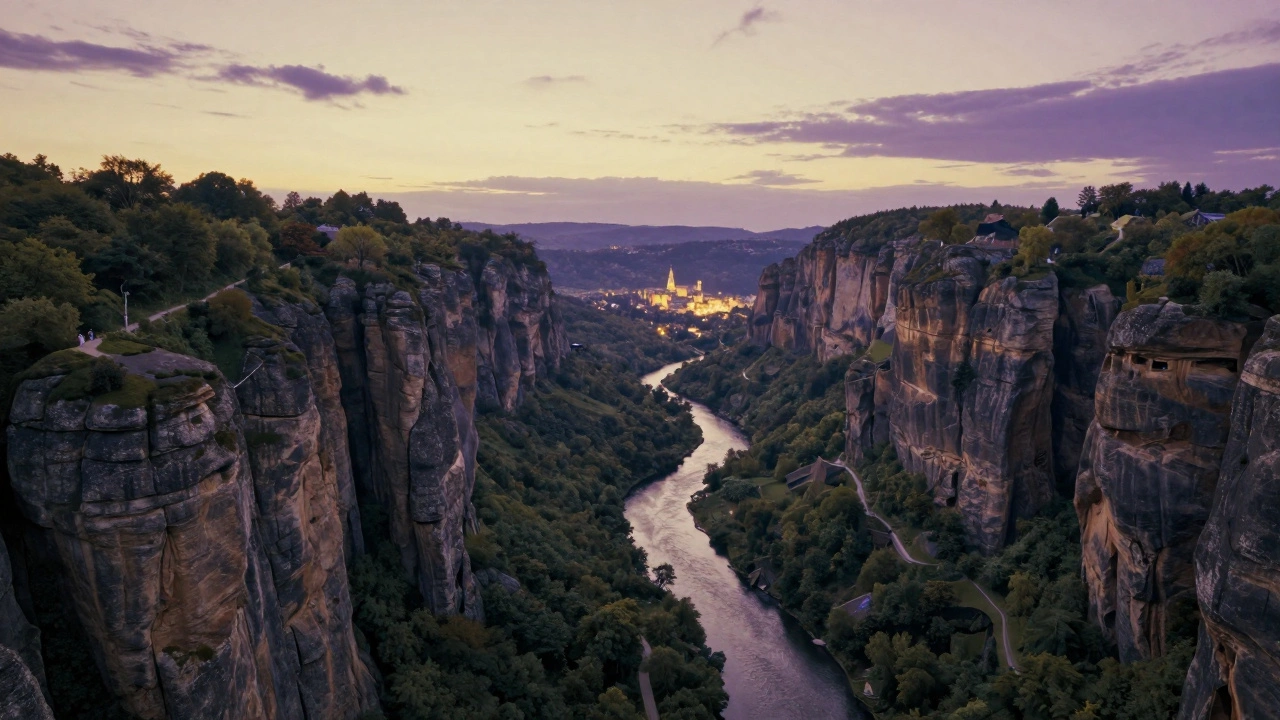
How This Changed Art History
Patinir’s breakthrough didn’t just create a new genre-it shifted how people saw the world. For centuries, nature had been seen as something to fear, control, or ignore. Patinir showed it could be beautiful, vast, and meaningful on its own.
By the 1600s, landscape painting exploded in the Netherlands. Artists like Rembrandt, Hobbema, and Meindert Hobbema painted forests, dunes, and canals with quiet reverence. In Italy, the Carracci family turned landscape into a formal academic subject. By the 1800s, Turner and Constable were painting skies and storms as emotional experiences.
All of it traces back to Patinir. He didn’t just paint a landscape. He gave permission to the entire art world to look at the earth and say: this matters.
Where to See the Original
The most famous version of Patinir’s World Landscape hangs in the Museo del Prado in Madrid. Another version, called Landscape with the Flight into Egypt, is in the Louvre. Both show his signature style: towering rocks, winding rivers, and tiny figures lost in the immensity of nature.
These aren’t just old paintings. They’re the starting point of how we see nature in art today. Walk through any modern gallery, and you’ll see his influence-in the wide-angle shots of Ansel Adams, in the sweeping vistas of Studio Ghibli films, even in the background of a Netflix period drama.
Why This Still Matters
Today, we take landscape art for granted. We scroll through Instagram photos of mountains, post sunset shots on Facebook, hang prints of forests in our living rooms. But we forget: once, this wasn’t normal. Once, nature wasn’t considered worthy of being the subject of a painting.
Patinir changed that. He didn’t just invent a style. He changed how humans relate to the natural world through art. He showed that beauty doesn’t need a divine figure to be meaningful. The land itself-its rocks, rivers, and skies-can be enough.
If you’ve ever stood on a cliff, felt small under a big sky, or paused to watch the light change over a valley-you’ve felt what Patinir wanted us to feel. He didn’t just paint the first landscape since antiquity. He gave us a new way to see the world.
Is Joachim Patinir’s painting really the first landscape since antiquity?
Yes, based on current art historical consensus. While earlier artists like the Romans painted landscapes, and Northern Renaissance painters added more background detail, Patinir was the first to make a landscape the sole subject of a finished, large-scale painting meant for public display. His works removed religious figures from center stage and placed nature as the primary focus.
What makes a painting a ‘landscape’ versus just a background?
A true landscape painting treats the natural environment as the main subject-not just a setting. The composition, lighting, and emotional tone are all shaped by the land itself. In Patinir’s work, the figures are small, symbolic, and secondary. The mountains, rivers, and skies carry the meaning. That’s what separates it from earlier works where nature was just a frame for a biblical scene.
Did Patinir paint from real locations?
No. Patinir created imaginary landscapes by combining features from different regions-Alpine peaks, Flemish valleys, and Mediterranean coastlines. He wasn’t interested in topography. He wanted to evoke a sense of wonder and scale, so he built idealized worlds that felt real but weren’t tied to any one place.
Why didn’t earlier artists paint landscapes as subjects?
Medieval and early Renaissance art was dominated by religious themes. The Church commissioned most art, and its goal was to teach scripture, not celebrate nature. Nature was seen as fallen or dangerous-something to be overcome, not admired. Patinir’s work reflected a growing humanist interest in the natural world, separate from religious doctrine.
How did Patinir’s style influence later artists?
His three-layer composition-foreground, middle ground, distant horizon-became the standard for landscape painting. Artists like Pieter Bruegel, Peter Paul Rubens, and later Dutch masters copied his structure. Even today, landscape photographers and filmmakers use the same visual rhythm to create depth and emotional impact. He didn’t just start a trend-he set the rules.