Watercolor Art Value Estimator
Estimate Your Watercolor Value
Estimated Value
Based on market trends for watercolor artworks
Values are approximate and vary based on auction results, provenance, and market conditions
Watercolor isn’t just for kids’ school projects or lazy Sunday afternoons. Some of the most powerful, enduring artworks in history were made with nothing but pigment, water, and paper. If you’ve ever seen a misty landscape that feels like it’s breathing, or a portrait where light seems to glow from within, you’ve likely been looking at watercolor. And yes - the world’s most famous artists didn’t just dabble in it. They mastered it.
John Singer Sargent: The Master of Light and Flow
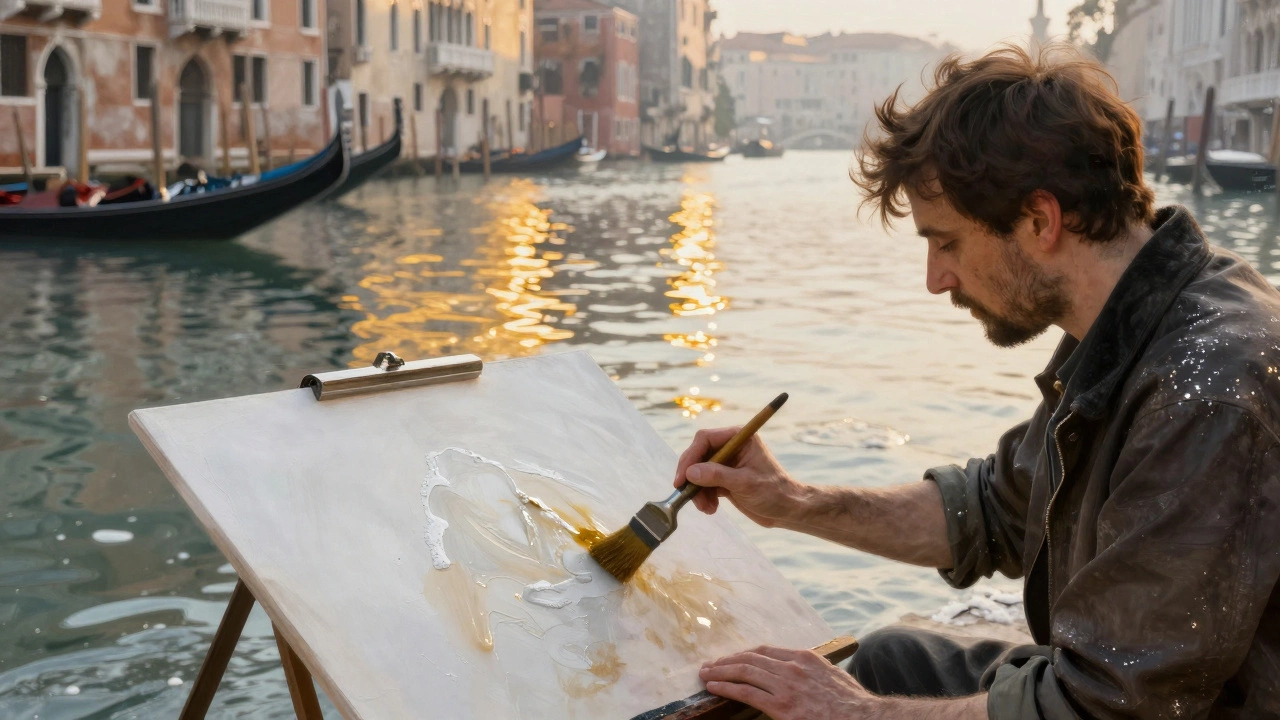
When people think of watercolor, they often picture soft, dreamy scenes. John Singer Sargent shattered that idea. He used watercolor to capture movement, texture, and emotion with a precision that stunned even his oil-painting peers. His 1904 piece Venice: The Grand Canal isn’t just a view of Italy - it’s a dance of wet-on-wet washes and sharp, controlled lines that make the water look alive. Sargent painted over 2,000 watercolors in his lifetime, mostly on location, often in under an hour. He didn’t sketch first. He just went for it. And somehow, it always worked.
What made him different? He treated watercolor like a fast-moving conversation. He let the paint bleed where it wanted, then steered it with a dry brush. He didn’t hide the paper. He used its whiteness as part of the composition. You can see this in Carrying the Water, where the white of the paper becomes the foam on a woman’s bucket as she walks through a dusty Spanish village.
Winslow Homer: Nature’s Raw Emotion
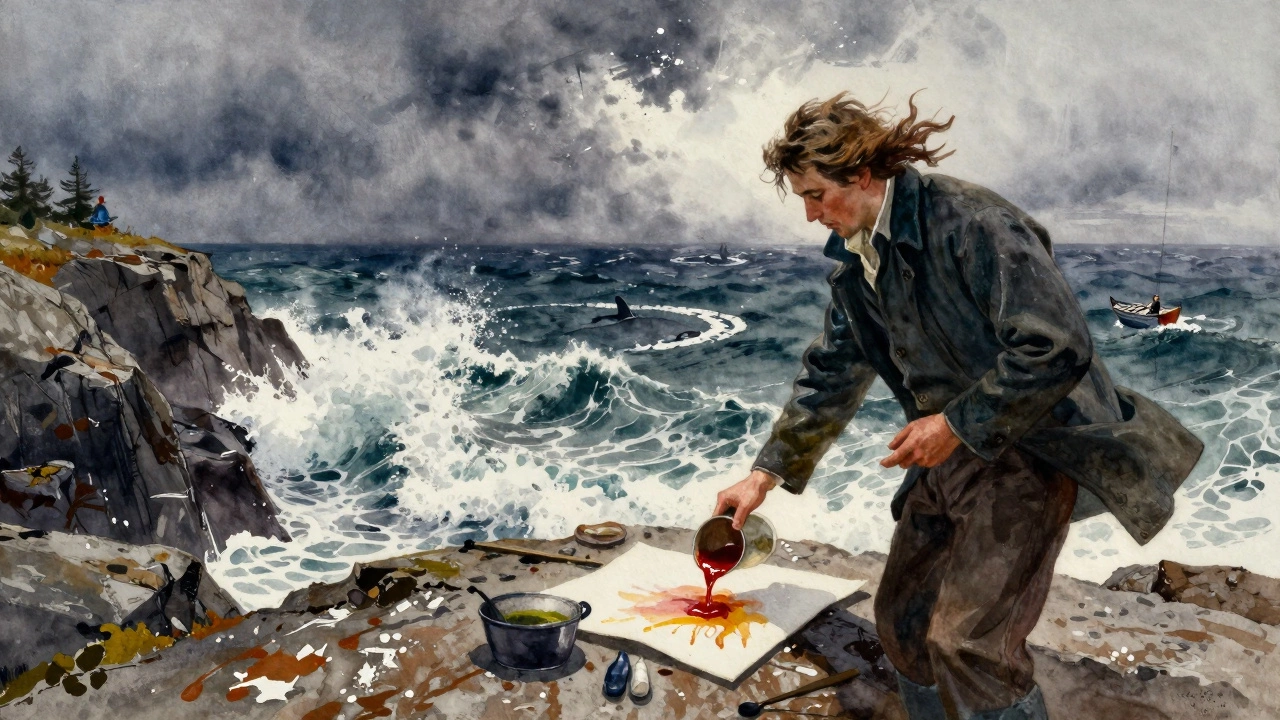
If Sargent painted with elegance, Winslow Homer painted with grit. He didn’t care about pretty. He cared about truth. His watercolors of the Atlantic coast - especially those from his time in Prouts Neck, Maine - show waves crashing with terrifying force. In The Gulf Stream (1899), a single man floats on a broken boat, surrounded by sharks, under a sky that’s half storm, half calm. The watercolor doesn’t soften the danger. It amplifies it.
Homer didn’t use brushes for everything. He’d drip, pour, and scrape paint. He’d lift color off the paper with a rag. He’d scratch lines into wet paint with the end of his brush. His technique wasn’t taught in academies. He figured it out by staring at the sea for hours. And his watercolors became some of the most respected American artworks of the 19th century.
J.M.W. Turner: The Painter of Atmosphere
Turner didn’t just use watercolor - he turned it into something almost supernatural. In the early 1800s, most artists used watercolor for sketches or travel journals. Turner made it his main medium for large-scale, dramatic works. His Rain, Steam, and Speed - The Great Western Railway (1844) looks like a storm caught mid-scream. The train is barely visible. The steam, the rain, the light - that’s what you feel. That’s what he painted.
Turner’s watercolors were bold. He layered glazes until the paper looked like stained glass. He mixed pigments with gum arabic and salt to create texture. He’d wet the paper, pour in color, then tilt the sheet until the paint rushed into shapes he couldn’t control. And then he’d stop it - just in time. He didn’t paint what he saw. He painted what it felt like to be there.
Mary Cassatt: Intimacy in Transparent Washes
While male artists were painting grand landscapes and battles, Mary Cassatt turned her watercolors inward. She painted mothers and children - quiet moments of tenderness. Her 1880 work The Child’s Bath uses watercolor’s transparency to make skin look soft, fabric look heavy, and water look real. There’s no drama. No heroics. Just a woman gently washing her child’s feet, sunlight falling across the floor.
Cassatt learned watercolor from Degas, but she made it her own. She didn’t rely on outlines. She built form with layers of pale washes, letting each layer dry before adding the next. Her colors were subtle: pale pinks, dusty blues, warm creams. You have to look closely. But when you do, you feel the warmth. You feel the quiet.
Georgia O’Keeffe: Abstraction Through Transparency
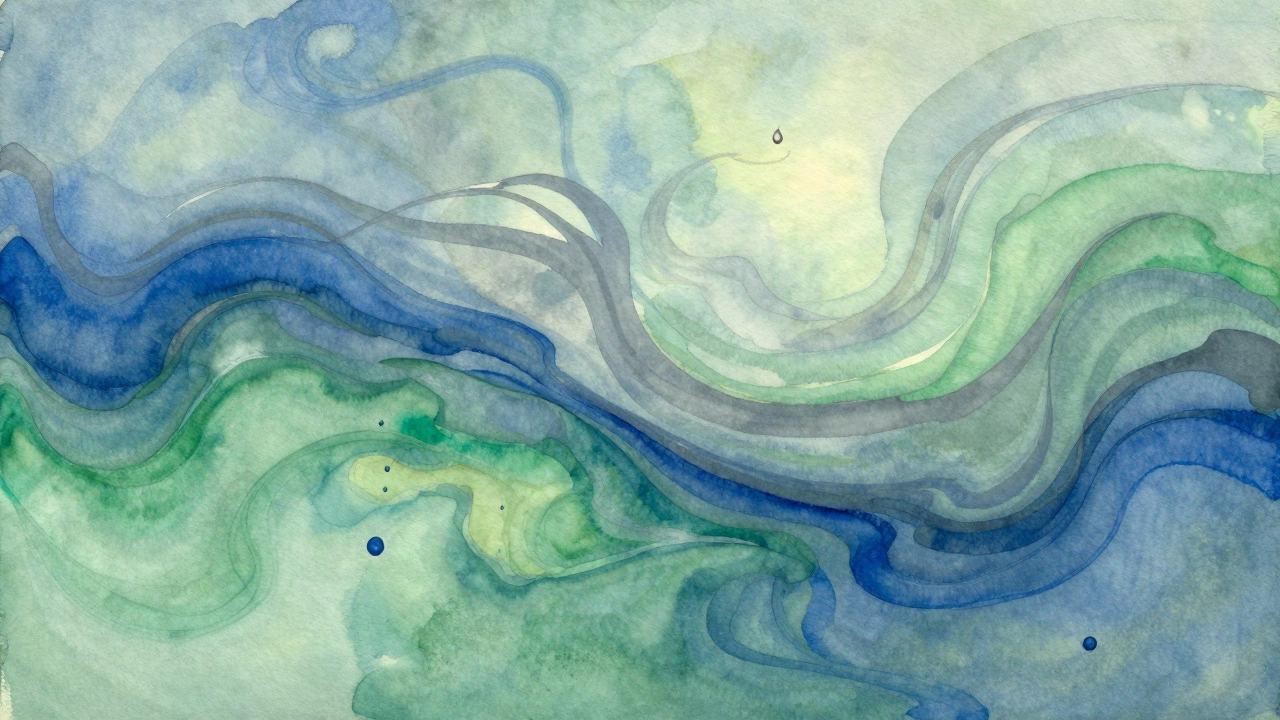
Most people know Georgia O’Keeffe for her giant flowers and desert bones - painted in oil. But before she became famous for those, she was experimenting with watercolor in the 1910s. Her early watercolors, like Blue and Green Music (1919), aren’t flowers or landscapes. They’re feelings made visible. Swirls of blue, streaks of green, smudges of gray - they don’t represent anything specific. They just feel like music.
O’Keeffe used watercolor because it let her move fast. She’d soak the paper, then let the colors run into each other. She’d blow on the wet paint to create unexpected shapes. She didn’t draw outlines. She let the medium guide her. These early watercolors were her training ground. They taught her how to simplify, how to let emptiness speak, how to make color carry emotion.
Modern Watercolor Artists Still Pushing Boundaries
The tradition didn’t end in the 1900s. Today, artists like David Hockney use watercolor for vibrant, colorful landscapes - often painted on iPad, but still rooted in watercolor’s fluidity. Andrew Wyeth’s Christina’s World started as a watercolor sketch before becoming an oil masterpiece. Albrecht Dürer painted intricate animal studies in watercolor over 500 years ago - and they still look fresh.
Even street artists are picking it up. In Tokyo, artists paint watercolor murals on wet concrete, letting the rain blend the colors overnight. In Mexico, indigenous painters use natural pigments mixed with water on handmade paper, continuing traditions that go back centuries.
Why Watercolor Still Matters
It’s not about the tool. It’s about the mindset. Watercolor doesn’t let you hide mistakes. You can’t paint over it. You have to plan, but also let go. You have to trust the process. That’s why so many great artists chose it - not because it was easy, but because it forced honesty.
Watercolor doesn’t need gold leaf or thick layers of oil. It needs patience. Observation. Courage. And it rewards those who listen to the paper, the water, and the pigment. The most famous artists didn’t just use watercolor. They let it speak.
Can watercolor be as valuable as oil painting?
Yes. Watercolor paintings by John Singer Sargent, J.M.W. Turner, and Winslow Homer have sold for over $10 million at auction. Their value comes from mastery, not medium. A watercolor by Turner can be more expensive than an oil by a lesser-known artist. The market judges the hand behind it, not the brush.
Do professional artists still use watercolor today?
Absolutely. Watercolor is used in illustration, fine art, and even scientific documentation. Artists like David Hockney, Julie Mehretu, and Alex Katz still use it regularly. Art schools teach it as a core skill because it teaches control, speed, and sensitivity to materials. It’s not a beginner’s medium - it’s a discipline.
Is watercolor harder than oil or acrylic?
Many artists say yes. Oil and acrylic let you rework areas, blend colors on the canvas, and fix mistakes. Watercolor doesn’t. Once the pigment hits the paper, it’s there. You can’t scrape it off. You can’t paint over it without muddying the color. That’s why mastering watercolor takes years - and why those who do are often considered some of the most skilled painters.
What makes watercolor unique compared to other paints?
Watercolor is transparent. It lets light reflect off the white paper beneath, giving it a luminous glow you can’t get with opaque paints. It moves quickly, responds to moisture, and blends in ways that feel alive. It’s unpredictable - and that’s its power. It doesn’t just show you what something looks like. It shows you how it feels to be there.
Did any famous female artists use watercolor?
Yes. Mary Cassatt is the most well-known, but others like Elizabeth Murray, Georgia O’Keeffe, and Emily Carr used watercolor extensively. Carr painted the forests of British Columbia in watercolor, capturing mist and trees with loose, emotional strokes. These artists used watercolor not as a secondary medium, but as their primary voice.