Watercolor Paper Selector
Find your ideal watercolor paper based on your experience level, project type, and preferences. This tool helps you avoid common mistakes like warping, bleeding, and poor color absorption.
Recommended Paper
Why this paper works for you
- 100% cotton fibers
- Archival quality (no yellowing)
- Cold press texture for versatility
- 140 lb weight for balance
When you pick up a watercolor brush, the first thing you need to know isn’t the color you’re about to use-it’s what you’re painting on. Watercolor doesn’t behave like oil or acrylic. It soaks, bleeds, and lifts. If you paint it on the wrong surface, your washes turn muddy, your edges blur into nothing, and your painting falls apart before it even dries. So what do most watercolor artists actually paint on? The answer isn’t complicated, but it’s specific: watercolor paper.
Why Watercolor Paper Is the Default Choice
Watercolor paper is made differently from regular printer paper or sketchbook pages. It’s built to handle large amounts of water without warping, tearing, or dissolving. Most artists use paper made from 100% cotton fibers, which absorb water evenly and hold pigment without bleeding uncontrollably. Cotton paper also lasts longer-it won’t yellow or become brittle over time like wood-pulp paper.Think of it like this: if you poured a glass of water onto a tissue, it would fall apart. But if you poured it onto a thick cotton towel, it would soak in slowly and stay intact. That’s the difference between regular paper and watercolor paper.
Over 90% of professional watercolorists use cotton-based watercolor paper. Even beginners are told to start with it, not because it’s expensive, but because it makes learning possible. Trying to paint watercolor on printer paper is like trying to ride a bike with flat tires-you’ll get frustrated fast.
How Watercolor Paper Is Made
Watercolor paper comes in three main types based on how it’s manufactured: hand-made, mold-made, and machine-made. Hand-made paper is the most expensive and has irregular, feathered edges. It’s prized by traditional artists for its texture and durability. Mold-made paper, made on rotating cylinders that mimic hand-making, is the most common choice among professionals. It’s consistent in quality, affordable, and still has the fiber alignment that helps control water flow.Machine-made paper is the cheapest and often made from wood pulp. It’s okay for practice, but it won’t hold up to multiple washes or heavy scrubbing. Most art supply stores stock mold-made cotton paper as the standard. Brands like Arches, Fabriano, and Saunders Waterford are trusted by artists worldwide because they’ve been making it the same way for over 200 years.
Surface Textures: Hot Press, Cold Press, and Rough
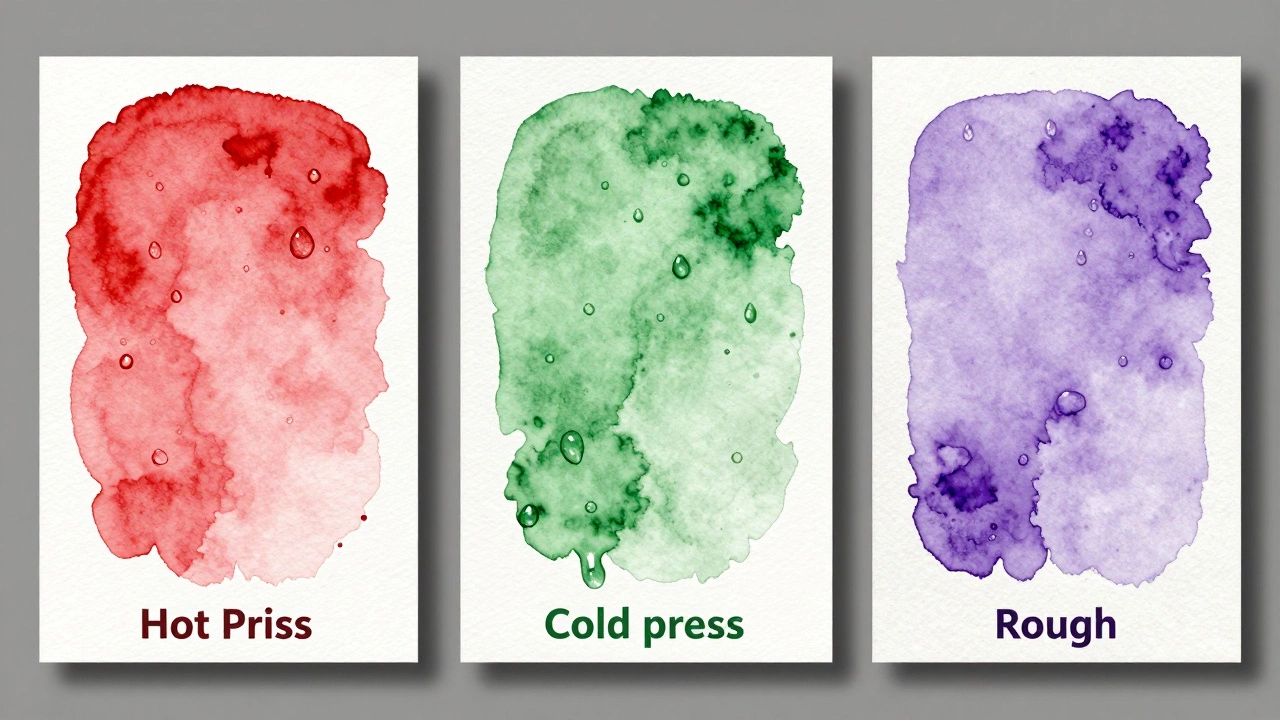
Not all watercolor paper feels the same. The surface texture changes how paint behaves. There are three main finishes:- Hot press is smooth, almost like cardstock. It’s great for fine details, illustrations, and tight linework. It doesn’t hold a lot of water, so it’s not ideal for big washes.
- Cold press has a slight texture-like a gentle pebble surface. This is the most popular choice. It holds water well, allows for blending, and gives paint a nice granular look. Over 70% of watercolor artists use cold press as their go-to.
- Rough has deep valleys and peaks. It creates dramatic textures, perfect for landscapes, skies, and abstract effects. But it’s harder to control for precise shapes or fine lines.
Most beginners start with cold press. It’s forgiving. It lets you make mistakes and still get beautiful results. If you’ve ever seen a watercolor painting with soft clouds, flowing rivers, or textured trees, it was likely painted on cold press paper.
Weight Matters: 140 lb vs. 300 lb
Paper weight is measured in pounds (lb) or grams per square meter (gsm). The higher the number, the thicker and more water-resistant the paper. You’ll see two main weights: 140 lb (300 gsm) and 300 lb (640 gsm).140 lb paper is the most common. It’s sturdy enough for most techniques but will buckle if you use too much water. That’s why artists stretch it-taping it down to a board before painting so it doesn’t warp. It’s affordable and perfect for practice, travel, and quick studies.
300 lb paper doesn’t need stretching. It’s thick enough to handle soaking, scrubbing, and multiple layers without bending. It’s the choice for finished pieces, exhibitions, and serious work. It’s heavier, more expensive, and lasts longer. If you’re selling your paintings or entering them in shows, 300 lb is the standard.
What Else Do Artists Paint Watercolor On?
While paper is the default, some artists experiment with other surfaces. You might see watercolor on:- Watercolor blocks-sheets glued on all sides so they don’t warp. Just paint, let dry, then peel off the top sheet.
- Yupo paper-a synthetic, non-absorbent surface. Watercolor sits on top and can be lifted off like ink on plastic. It’s great for abstract effects but doesn’t behave like traditional watercolor.
- Wood panels-sized with gesso and sealed. Used by some contemporary artists for mixed media work.
- Canvas-but only if it’s specially primed with watercolor ground. Regular canvas will repel water and cause paint to bead up.
These alternatives are niche. They’re used by artists who want to break the rules or achieve specific effects. But if you walk into any art supply store and ask for watercolor supplies, the first thing you’ll see is a stack of watercolor paper. That’s because it’s the only surface that reliably works with watercolor’s natural behavior.
Why Other Surfaces Don’t Work Well
You might think, “Why not paint on regular paper? I’ve seen people do it.” You can-but you’ll run into problems. Regular paper is thin and full of wood fibers that break down when wet. Watercolor will bleed uncontrollably, colors will look dull, and the paper will curl into a potato chip shape.Even cardstock, which feels thick, isn’t designed for water. It may hold up for one light wash, but two or three layers will cause it to buckle or tear. And if you try to lift paint to correct a mistake? The surface will pill, leaving fuzzy bits stuck to your brush.
Canvas without special treatment is worse. Watercolor sits on top like oil on water. It doesn’t sink in, so you can’t blend or layer properly. It looks flat, lifeless, and unnatural.
What to Look for When Buying Watercolor Paper
If you’re buying watercolor paper for the first time, here’s what to check:- 100% cotton-avoid paper labeled “wood pulp” or “cellulose.”
- 140 lb or 300 lb-start with 140 lb unless you’re doing serious work.
- Cold press-the most versatile surface.
- Archival quality-means it won’t yellow or fade over time.
- Brand reputation-Arches, Fabriano, Canson, and Saunders Waterford are industry standards.
Don’t buy the cheapest pad you find at the big-box store. It might save you $5 now, but you’ll waste more time and frustration later. Good paper makes the difference between a painting that looks professional and one that looks like a mess.
Final Thought: It’s Not Just a Surface-It’s a Partner
Watercolor paper isn’t just a place to put paint. It’s an active part of the process. It controls how the water moves, how the pigment settles, and how the colors bloom. A skilled artist doesn’t just paint on paper-they work with it. They let the paper breathe, absorb, and react. That’s why the best watercolor paintings feel alive. They’re not just drawn-they’re grown.So if you’re starting out, get a pad of 140 lb cold press, 100% cotton watercolor paper. Don’t overthink it. Just paint. You’ll learn more from ten failed attempts on real paper than from one perfect painting on the wrong surface.
Can I use regular printer paper for watercolor?
No, regular printer paper isn’t designed for water. It will warp, tear, and bleed uncontrollably. Colors will look dull, and you won’t be able to lift or blend paint properly. It’s not worth the frustration-use proper watercolor paper instead.
What’s the difference between cold press and hot press watercolor paper?
Cold press has a slight texture that holds water and pigment well, making it ideal for blending and washes. Hot press is smooth, perfect for fine details and illustrations but doesn’t hold as much water. Cold press is the most popular choice for general watercolor work.
Do I need to stretch watercolor paper?
You only need to stretch 140 lb paper if you’re using a lot of water. 300 lb paper is thick enough to handle wet washes without buckling. Stretching involves taping the paper to a board with masking tape so it dries flat.
Is 100% cotton paper really that much better?
Yes. Cotton fibers are longer and stronger than wood pulp, so they absorb water evenly and don’t break down under repeated washes. Cotton paper also lasts longer-decades without yellowing. It’s the standard for professional work.
Can I paint watercolor on canvas?
Only if it’s treated with watercolor ground, a special primer that makes canvas absorb water like paper. Regular canvas repels water, causing paint to bead up and look unnatural. Most artists stick to paper for traditional watercolor.