Musical Synesthesia Color Mapper
Choose a note from the chromatic scale to see how different theories map sound to visual color.
Goethe / Classical
General Perception
Messiaen / Others
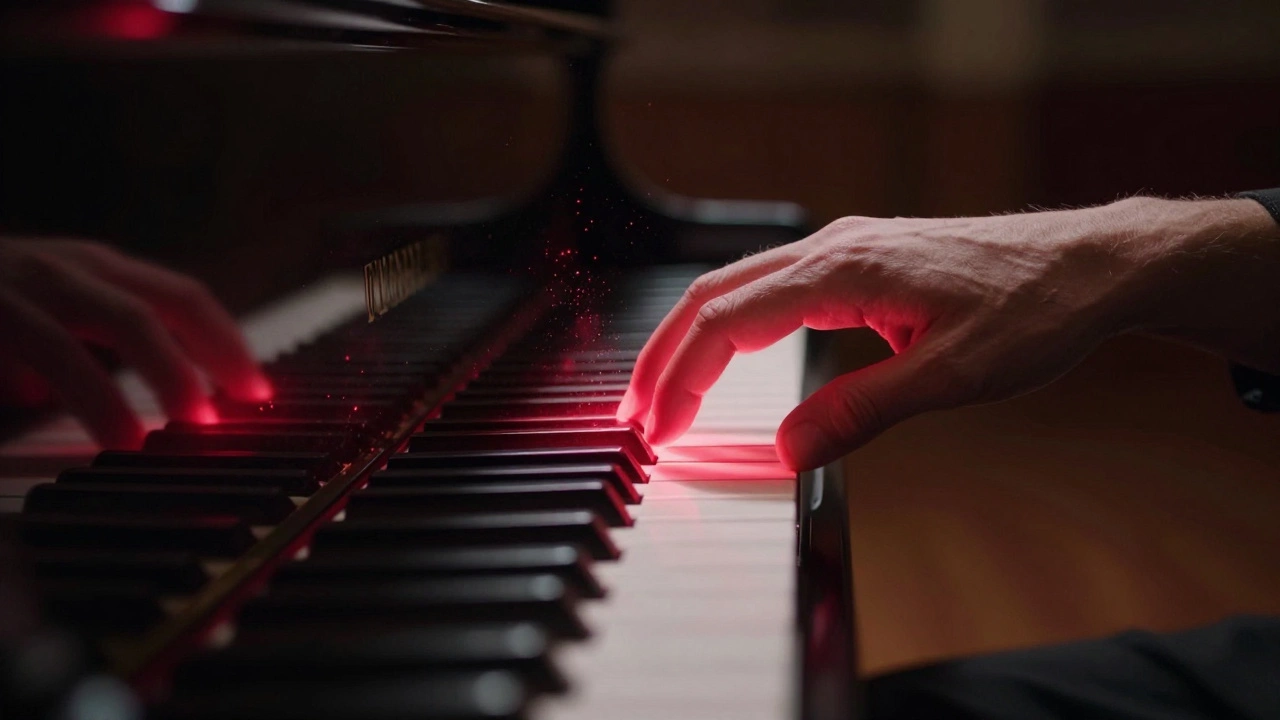
You hear a piano play a single key. It vibrates through your chest. Now imagine closing your eyes and seeing a flash of red. If that sounds familiar to you, you might be part of a small group of people who perceive music differently. But if you see nothing special, you probably have the standard way of processing sound. This brings us to the strange question many beginners and seasoned artists alike ask: What color is the note C? There is no physical property linking sound waves to light waves. Yet, history, art, and neuroscience suggest a deeper connection between the two senses.
The Phenomenon of Chromesthesia
First, we need to define what connects sound to sight. It is called chromesthesia, which falls under the broader umbrella of synesthesia. When a musician asks about the color of C, they are usually referring to this specific type of sensory crossover. For most people, music remains purely auditory. However, roughly 4% of the population experiences automatic, involuntary perceptions when stimulated by one sense that triggers another.
If you turn a lamp brighter, you might feel like the music gets louder. Or, if you hear a high trumpet note, you might visualize something sharp and yellow. In the case of the specific note C, the associations vary wildly from person to person. There is no universal "correct" answer found in nature because sound frequencies and light wavelengths operate independently. Sound is vibration traveling through air, measured in Hertz. Light is electromagnetic radiation, measured in nanometers. Physics separates them entirely.
Historical Attempts to Map Color and Sound
Just because physics says no doesn't mean humans haven't tried to link them. Throughout the 19th and 20th centuries, composers attempted to organize these feelings into systems. One famous figure was Alexander Scriabin. He developed a theory called "the circle of chords," linking specific notes to specific hues. In his mind, the key of C-sharp minor was blue. He believed that major keys leaned toward lighter, warmer colors like yellow and orange, while minor keys felt colder and darker, leaning toward violet or black.
| Composer/Theorist | System Used | Note C Association |
|---|---|---|
| Alexander Scriabin | Circle of Chords | Not explicitly C Major, often associated with warmth (red/yellow) |
| Olivier Messiaen | Mystical Synesthesia | Saw C as a bright, burning red |
| Goethe | Color Theory | Linked F to Blue, C to Red |
| Modern Psychology | Average Perception | C often perceived as Red or White |
Olivier Messiaen provides another compelling example. He was a French composer who described his internal vision of music vividly. Unlike Scriabin, who tried to build a logical organ mechanism to project colors, Messiaen described his personal experience poetically. To him, the tone C appeared as a distinct shade of red. He argued that this wasn't metaphorical; it was a literal visual experience that occurred in his mind when he heard the tone. This suggests that while there is no universal rule, individual neural wiring dictates the specific color attached to the pitch.

Neuroscience Behind the Experience
Why does this happen in the first place? Research from the past decade has illuminated the brain structures involved. Scientists using MRI scans observed hyperconnectivity in certain regions of the brain. Typically, the auditory cortex handles sound signals, while the visual cortex handles images. In people with synesthesia, the pathways between these areas show increased activity.
Specifically, researchers have noted cross-activation in the V4 area of the temporal lobe, which is responsible for color processing. When a C major chord plays, the signal reaches the auditory center but spills over into the visual center before being filtered out. This explains why the experience feels involuntary. You can't choose to stop seeing the color; it's a biological feature, not a learned trick.
This neurological overlap also explains why absolute pitch holders often have higher rates of synesthesia. If your brain is highly specialized to distinguish pitch heights accurately, it may be more likely to form connections between different sensory modalities. Some studies suggest early childhood exposure plays a role, but genetics appear to be the primary driver.
Cultural Conditioning vs. Biological Reality
Not everyone seeing color hears a synesthetic signal. Sometimes, color associations come from cultural training rather than biology. In music education, specifically in French solfège traditions, teachers sometimes assign colors to notes to help students memorize scales. In these classroom settings, C might be marked with a red sticker on the keyboard. Over time, a student develops a strong mental link between the symbol "C" and the concept of "Red."
This differs significantly from true synesthesia. The trained association is cognitive. If you remove the red sticker, the connection weakens. True synesthetes cannot detach the color from the sound, even if they try. If you ask a random group of musicians to guess the color of C, many will say Red. They aren't necessarily feeling it physically; they are recalling the visual aid they saw years ago. This distinction is vital when diagnosing whether an artist truly has the condition or simply remembers a teaching tool.
Furthermore, cultural metaphors play a massive role. We speak of "warm" bass tones and "cold" treble notes. We describe music as "bright." These linguistic habits shape our collective intuition. When asked broadly, humans tend to associate low pitches with dark, cold colors like blue or purple, and high pitches with bright, warm colors like yellow or red. This shared psychological tendency creates a consensus that feels like a fact, even though it is just a metaphor made habitual by language.

Practical Applications for Musicians
For those of you who do experience this, or those curious to explore the intersection, how does it affect playing? Many guitarists and pianists claim they "see" their sheet music differently. Some argue that understanding these associations helps with improvisation. If you know a chord progression feels like moving from a warm landscape to a cold one, you can adjust your dynamics accordingly.
However, relying solely on personal color cues can be risky in ensemble settings. If you see a transition to a "blue" section but your bandmates hear the change as "gray," communication gaps occur. Professional orchestras prioritize standard terminology like tempo, dynamic markings (forte, piano), and articulation over abstract sensory descriptions. Using color metaphors in rehearsals is generally discouraged unless every member understands the shared shorthand.
That said, technology is catching up. Digital audio workstations now allow producers to visualize audio waveforms with customizable color schemes. While this mimics synesthesia artificially, it allows all producers to "color-code" their sessions. You can set the kick drum track to a heavy red hue and the hi-hats to a crisp silver line in the timeline. This isn't biological synesthesia, but it serves a similar functional purpose: organizing auditory information visually for better workflow efficiency.
The Debate on Universal Mapping
Finally, scientists still debate whether any mapping is universal across all humans, regardless of whether they have synesthesia. Cross-cultural studies reveal inconsistencies. Western listeners might associate lower pitches with darker colors due to the correlation between large objects (which reflect less light) and deep sounds. Conversely, East Asian studies sometimes show different correlations depending on the traditional instruments used. The tonal systems of Chinese pentatonic scales do not map neatly onto the Western 12-tone equal temperament system where Note C sits.
If the universe were perfectly designed for consistency, every human should agree on the color of C. But the brain is plastic. It adapts. Your environment shapes your perception more than your DNA alone does. So, while we look for patterns, we must accept that the answer is highly subjective. You might see C as vibrant orange. Someone else sees pale grey. Both experiences are valid within their own neurological context.