Starry Night Comparison Tool
How Original Art Differs From Reproductions
This tool demonstrates key differences between Van Gogh's original painting and common reproductions, based on the article's details.
Key Differences
- Brushstrokes: Original has thick, layered oil paint (up to 1mm thick) with visible texture; reproductions use flat ink
- Color Depth: Original shows layered pigments (blue, green, umber) with subtle variations; reproductions appear flat
- Dimension: Original measures 73.7 x 92.1 cm; most reproductions shrink the image
- Light Sensitivity: Original requires climate-controlled environment; reproductions can tolerate normal lighting
Based on article details: The original's thick oil paint creates physical texture that cannot be replicated in prints. MoMA's conservation practices maintain its unique characteristics.
The Starry Night isn’t just a painting. It’s a cultural icon. You’ve seen it on posters, mugs, T-shirts, and phone cases. But here’s the real question: does the original still exist? And if so, where is it? The answer isn’t as simple as a yes or no-it’s wrapped up in history, obsession, and one man’s turbulent mind.
Where the Original Starry Night Lives
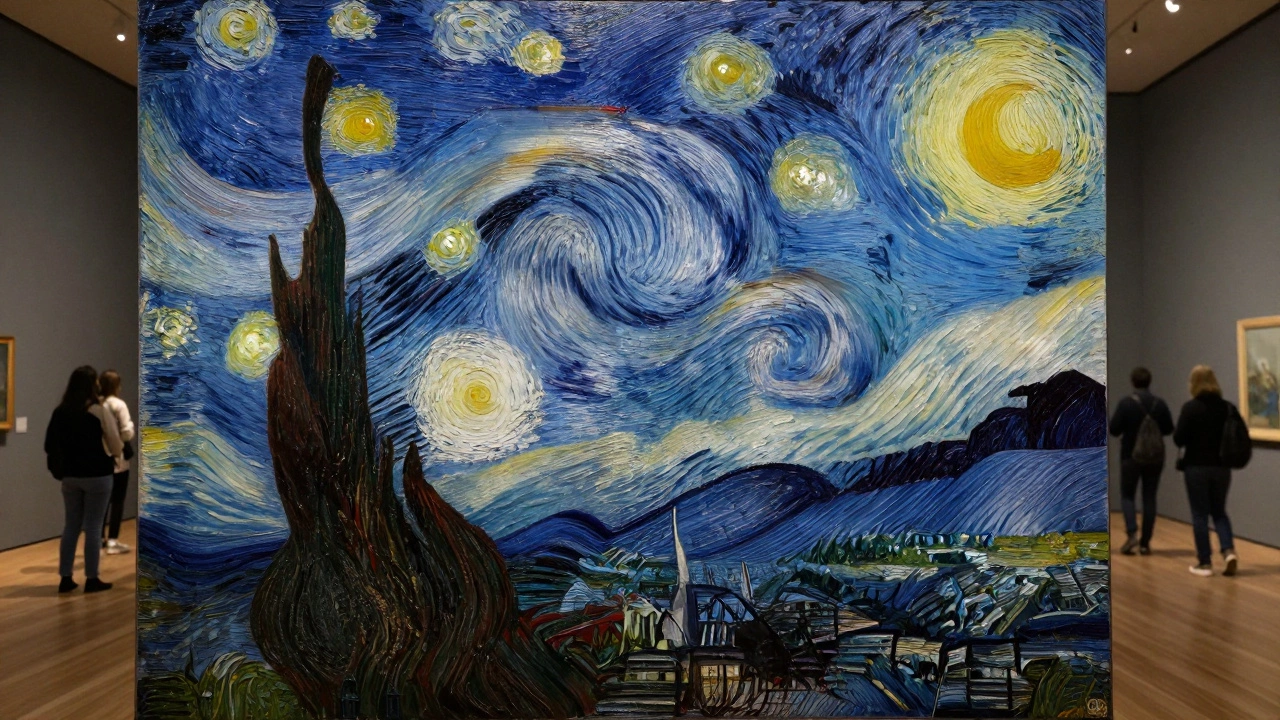
The original The Starry Night, painted by Vincent van Gogh in June 1889, still exists. It’s not lost, not destroyed, and not hidden away in a private collection. It’s on permanent display at the Museum of Modern Art (MoMA) in New York City. You can walk right up to it. No velvet ropes, no glass case that blocks your view-just the thick brushstrokes, swirling blues, and that glowing yellow moon, all exactly as Van Gogh left them.
MoMA acquired the painting in 1941 through the Lillie P. Bliss Bequest. Since then, it’s been one of their most visited works. Over 2 million people see it every year. That’s more than the population of Vancouver. And yet, most of them don’t realize they’re looking at the original. Many think they’re seeing a reproduction.
Why People Think It Might Be Gone
Why does this myth keep popping up? Partly because Van Gogh’s life was so chaotic. He painted over 900 works in just ten years, often using whatever materials he could find-old canvases, cardboard, even the backs of letters. He gave away paintings, traded them for food, and sometimes didn’t even sign them. So when you hear stories about lost masterpieces, it’s easy to believe one of his most famous pieces vanished too.
Another reason? The painting’s appearance. Van Gogh didn’t paint The Starry Night from memory. He painted it from his window at the Saint-Paul-de-Mausole asylum in Saint-Rémy-de-Provence, France. He was confined there after cutting off part of his ear. The sky he saw was real. But the swirls? The exaggerated stars? Those were his inner world. That emotional intensity makes people think the painting must’ve been destroyed-like it was too powerful to survive.
And then there’s the copycat culture. There are hundreds of reproductions. Some are high-quality. Others look like they were printed on a home printer. When people see a bad copy, they assume the original must’ve been lost-or worse, replaced.
What Makes the Original Unique
The original isn’t just the image. It’s the texture. The paint is thick. Van Gogh used oil paints straight from the tube. He layered them with a palette knife and stiff brushes. You can see ridges where the paint was pushed across the canvas. In some spots, the paint is over a millimeter thick. That’s not something a print can replicate.
Look closely at the cypress tree in the foreground. It’s not just black. It’s layered with dark green, deep blue, and touches of burnt umber. The stars aren’t just yellow-they’re flecked with white, orange, and even faint hints of red. The sky isn’t smooth. It’s alive with movement. That’s why art conservators at MoMA keep the lighting low and the humidity controlled. Even slight changes can affect how the paint ages.
There’s also the size. The original measures 73.7 cm × 92.1 cm (29 × 36.2 inches). Most posters shrink it down. The real thing fills your peripheral vision. You don’t just look at it-you feel it.
Has It Ever Been Moved?
Yes. And it’s been moved carefully. In 1973, it traveled to Japan as part of a Van Gogh exhibition. In 1986, it went to Amsterdam for a major retrospective. In 2009, it was part of a tour across the U.S. Each time, it was transported in a climate-controlled armored case. Armed guards. No flash photography. No touching. Even the humidity in the transport truck was monitored.
It’s never been loaned to a private collector. MoMA considers it too fragile, too valuable, and too important to risk. The museum has a strict policy: no private loans for this piece. It’s always on public view.
What About Other Versions?
Van Gogh painted at least two other night scenes around the same time. One is The Starry Night Over the Rhône, painted in 1888 in Arles. That one’s at the Musée d’Orsay in Paris. It’s calmer. The stars are softer. The water reflects the sky. It’s beautiful-but it’s not The Starry Night.
He also made a smaller sketch on paper, showing the same composition. That’s held by the Van Gogh Museum in Amsterdam. It’s not a painting. It’s a study. A draft. People sometimes confuse it with the original because it looks similar. But it’s not oil on canvas. It’s charcoal and ink.
And yes, there are hundreds of copies. Some painted by art students. Others by forgers. One famous fake was sold in 2015 for $120,000 before experts spotted the brushwork was too smooth. The real Van Gogh never painted smoothly. He painted with fury.
Can You See It in Person?
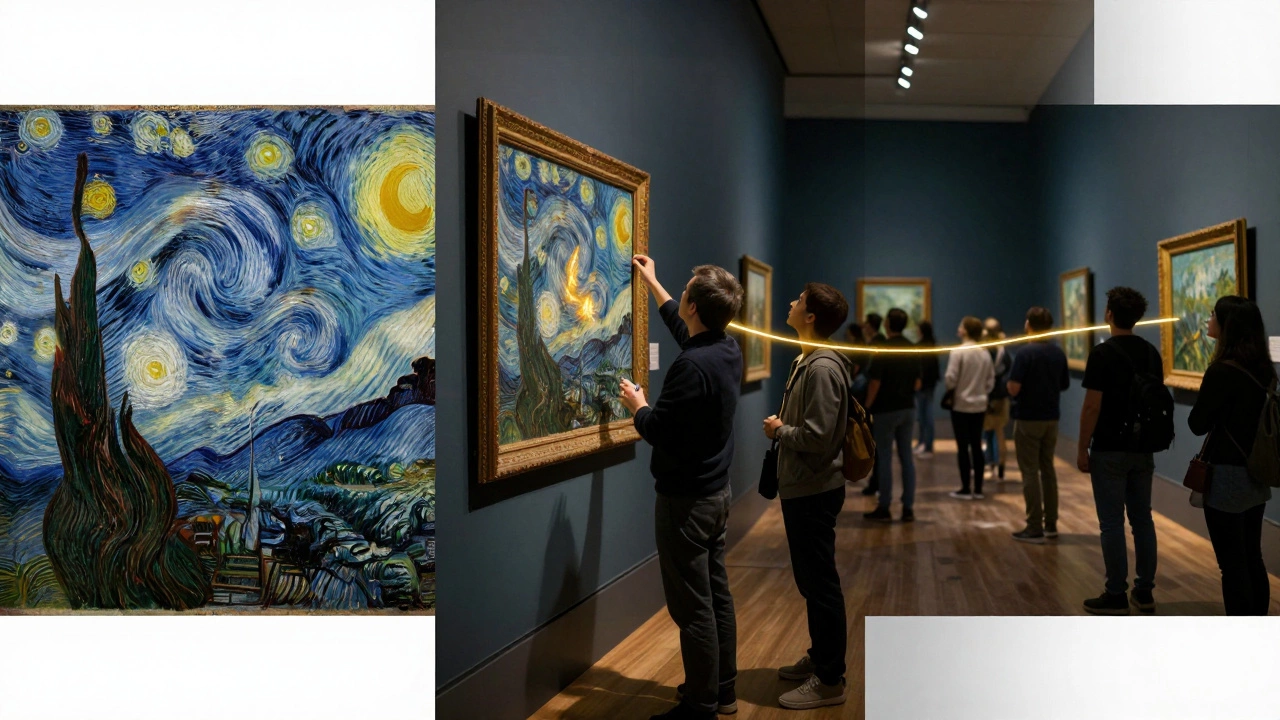
You absolutely can. MoMA’s Starry Night is in the second-floor Painting and Sculpture galleries. It’s usually near other big names-Picasso, Matisse, Pollock. The room is quiet. People stand in front of it for minutes. Some cry. Others take photos. A few sit on the bench across the room and just stare.
There’s no special ticket. You don’t need to book ahead. Just walk in. The museum is open daily, except for Thanksgiving and Christmas. If you go early in the morning, you’ll have it mostly to yourself. The light from the windows hits the painting just right around 10 a.m.
Why This Matters
Van Gogh sold only one painting in his lifetime. He died poor, alone, and largely ignored. Today, The Starry Night is worth over $100 million. But its value isn’t in the price tag. It’s in what it represents: a man who painted his pain, his wonder, his loneliness-and turned it into something the whole world still needs to see.
The original still exists. Not because it’s been hidden. Not because it’s been locked away. But because someone-MoMA, the art world, the public-decided it mattered too much to lose.
You can’t buy it. You can’t copy it. But you can stand in front of it. And for a few minutes, you’re not just looking at a painting. You’re looking into the mind of a genius who saw the sky differently-and dared to show it to us.
Is the original Starry Night on display anywhere besides MoMA?
No. The original is on permanent display at the Museum of Modern Art in New York City. MoMA has never sold it, loaned it to private collectors, or moved it to another museum long-term. It may travel for special exhibitions, but it always returns to MoMA. Other versions, like the sketch or The Starry Night Over the Rhône, are in different museums-but none are the original 1889 oil painting.
Can I buy a print of the original Starry Night?
Yes, you can buy high-quality prints from MoMA’s official store, art publishers, or reputable galleries. But be careful: many cheap prints are mass-produced and lack texture, color depth, and detail. The original has thick, layered brushstrokes you can’t replicate with ink. A good print will mention it’s a reproduction of the MoMA collection, and will include the dimensions (73.7 x 92.1 cm). Avoid anything labeled "original" unless it’s signed by Van Gogh-which is impossible, since he died in 1890.
Why is the original so fragile?
Van Gogh used thick oil paint, sometimes applied with a knife, which creates tension on the canvas. Over time, the paint can crack, especially where layers overlap. The canvas itself is linen, stretched tight over 130 years ago. Humidity, temperature, and even light exposure can cause damage. MoMA keeps it in a climate-controlled room with UV-filtered lighting and no natural sunlight. Conservators check it every few months for signs of flaking or discoloration.
Did Van Gogh paint multiple versions of Starry Night?
He painted one definitive version in June 1889, which is the one at MoMA. But he made a smaller pencil and ink sketch of the same scene before painting it. He also painted The Starry Night Over the Rhône in 1888, which is similar but shows a different view of the night sky over water. These are related works-not versions of the same painting. The MoMA version is the only full oil painting with the swirling sky, cypress tree, and village he described in his letters.
How do experts know the MoMA painting is the real one?
Provenance. The painting has a clear paper trail: Van Gogh painted it in Saint-Rémy, gave it to his brother Theo, who kept it until his death. Theo’s widow later sold it to art dealer Julien Leclercq, who passed it to collector Bernhard Koehler. In 1941, Lillie P. Bliss donated it to MoMA. Experts also matched the canvas, paint chemistry, and brushwork to Van Gogh’s known materials and techniques. X-rays and infrared scans show underdrawings consistent with his other works. No other painting matches all these details.